
Assisted Opening vs. Automatic Knife: Key Differences

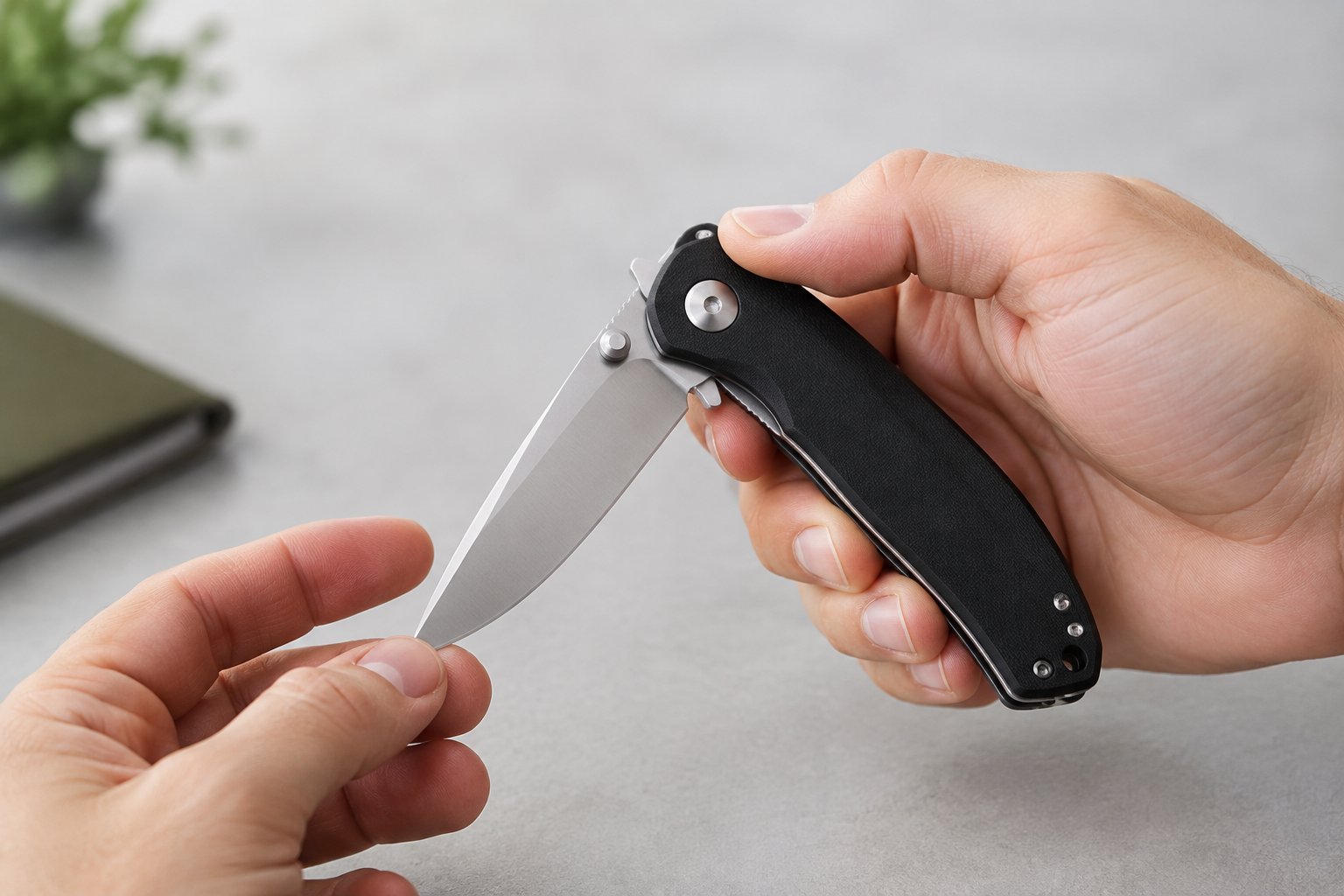
Standing at a counter looking at two folders that both snap open fast, it’s easy to assume they work the same way. They don’t, and the difference matters more than most first-time buyers realize. The core split in the assisted opening vs. automatic knife debate comes down to one thing: who starts the blade moving.
An assisted opener needs your thumb to break the blade free before a spring or torsion bar finishes the job. An automatic knife needs nothing but a button press, and the spring does all the work from a fully closed position. That single mechanical detail changes how each knife feels in your hand, how it fits your daily routine, and whether it’s legal to carry where you live.
This guide explains how each mechanism works inside the handle, what that means for speed and safety in daily carry, and why the law treats them so differently. By the end, you’ll know which style fits your hands and your state.
How Does Each Opening Mechanism Work?
The mechanical line between these two knife types is simple to state and easy to feel once you handle both. One needs a push from you; the other doesn’t.
Assisted Openers Need a Manual Start
An assisted-opening knife stays closed under spring tension until you physically move the blade past its detent. Your thumb, a flipper tab, or a thumb stud provides that initial motion. Once the blade clears a few degrees of travel, a torsion bar or coil spring takes over and snaps it the rest of the way to lock.
That manual start is the design’s legal and mechanical heart. Without your input, the blade stays put no matter how hard you shake or drop the knife. Federal and state knife statutes rely on this distinction, and the reason is worth understanding before you shop by mechanism.
Automatic Knives Fire From a Button or Switch
An automatic knife, often called a switchblade, opens with zero manual assistance. Press the button or slide the switch, and an internal spring drives the blade from fully closed to fully locked. There’s no detent to break, no push to start; the mechanism does 100% of the work.
Side-opening automatics rotate the blade out like a folder, while out-the-front (OTF) automatics fire the blade straight out the front of the handle. Both count as automatic knives under most state statutes, regardless of how the blade travels.
- Assisted opener: blade starts closed, needs manual push, spring finishes the motion
- Automatic knife: blade starts closed, button or switch alone drives full deployment
- OTF automatic: blade fires straight out the front of the handle, still legally automatic
Why Kershaw SpeedSafe Is a Useful Assisted-Opening Example
Kershaw’s SpeedSafe mechanism is one of the most widely carried assisted-opening systems in the country, and it’s a good reference point for how the technology behaves. A flipper tab or thumb stud starts the blade moving, and a torsion bar spring locks it open in a fraction of a second.
Models like the Kershaw Leek and Blur use SpeedSafe, and both remain legal to carry in states where automatic knives face restrictions. That legal breathing room comes directly from the manual-start requirement, not a loophole. The next question is what that mechanical difference actually feels like when you use the knife every day.
What the Mechanism Changes in Daily Carry
The opening mechanism shapes far more than how fast the blade comes out. It affects control, pocket safety, and how much upkeep the knife needs over time.
Deployment Speed and One-Handed Operation
Both mechanisms open one-handed, but they don’t feel the same under stress or gloves. An automatic wins on raw speed because there’s no detent to overcome before the spring fires.
An assisted opener asks for a small amount of finger dexterity to break the detent, which can matter with cold hands or thick gloves. In practice, the speed gap between a well-tuned assisted knife and an automatic is smaller than most buyers expect. Neither mechanism replaces practice; muscle memory closes most of the gap either way.
Control, Pocket Safety, and Accidental Activation
Pocket safety comes down to how many ways a blade can accidentally open, and this is where the two designs genuinely differ. An assisted knife’s detent resists accidental opening because something has to physically push the blade first. An automatic’s button sits exposed on the handle, so a firm bump against a pocket seam can easily trigger it.
- Lower accidental-opening risk: assisted openers, thanks to detent resistance
- Higher accidental-opening risk if unlocked: automatics, due to exposed buttons
- Best mitigation for automatics: a secondary safety switch, standard on most modern autos
Most quality automatics include a sliding safety that blocks the fire button, and skipping that step is the single biggest cause of pocket mishaps.
Locks, Moving Parts, and Routine Maintenance
Automatics generally carry more internal parts than assisted openers, since the button, safety, and full-travel spring assembly all add complexity. That complexity raises the ceiling on what can go wrong, though routine care rarely causes issues.
Assisted knives typically use a liner lock, frame lock, or back lock, the same options found on manual folders. Automatics often rely on a button lock or a dedicated internal stop built into the firing mechanism itself.
A detail most first-time buyers miss: automatic knife pivots are rarely user-adjustable the way a manual flipper’s pivot is, since loosening the wrong screw can throw off spring tension. That’s another reason to know your local laws before you buy, which is where the conversation has to go next.
Why Automatic Knife Laws Are Different
Automatic knives face more legal restrictions than assisted openers because federal and state law define “automatic” by mechanism, not by looks. That single definition shapes carry rules nationwide.
How Statutes Commonly Define an Automatic Knife
The foundational federal law here is the Switchblade Act of 1958, codified at 15 U.S.C. § 1241, which defines a “switchblade knife” as any knife with a blade that opens automatically “by hand pressure applied to a button or other device in the handle,” or “by operation of inertia, gravity, or both.” Most states have written their own knife statutes around close variations of this same definition.
Courts distinguish whether the user’s hand must move the blade itself, or simply trigger a mechanism that does the moving. Assisted openers generally fall outside this definition because the blade won’t travel from closed to open without the user physically pushing it past its resistance, sometimes described as a “bias toward closure.” That’s a narrower legal test than it might sound, but it’s the line courts have upheld repeatedly.
Why Assisted Folders Are Legal in More Places
Assisted-opening knives sidestep that definition because the user provides the essential first motion. Since the blade cannot travel from closed to open without a manual push, most states classify assisted openers alongside ordinary folding knives rather than switchblades.
- Automatic knives: restricted or banned in a meaningful number of states and cities
- Assisted-opening knives: legal in the overwhelming majority of states as standard folders
- OTF automatics: treated the same as side-opening automatics under most statutes
That legal gap is the biggest practical reason buyers gravitate toward assisted models for everyday carry.
Oklahoma Rules and the Need to Verify Local Laws
Oklahoma repealed its statewide switchblade and automatic knife restrictions effective November 1, 2015. The current text of 21 O.S. § 1272 no longer lists switchblades or automatic knives among prohibited items, which puts Oklahoma in a more permissive category than many neighboring states.
State-level legality doesn’t erase every local wrinkle, though. City ordinances, school zones, and specific carry contexts can still add restrictions on top of state law. Verifying local rules before ordering an automatic is worth the five minutes, especially if you travel or carry across state lines. Once you understand the legal terrain, the real decision becomes which mechanism actually fits how you live day to day.
Which Opening Style Fits Your Needs?
Your daily habits should decide this more than spec sheets or looks. Assisted openers cover most everyday tasks, while automatics earn their keep in a narrower set of situations.
When a Spring-Assisted Folder Makes Sense for EDC
An assisted opener makes sense for most everyday carry needs: opening packages, breaking down boxes, food prep, and general utility cutting. The manual-start detent also gives you finer control over exactly when the blade releases, which matters for precision tasks.
Legal simplicity is the other major draw. Since assisted folders travel across state lines without the same scrutiny as automatics, they’re the safer default for anyone who crosses state borders for work or travel.
When an Automatic Is Worth Considering
An automatic knife earns consideration when one-handed speed under real stress outweighs the added legal homework. That includes some professional contexts, like certain first-responder or maritime roles where a single free hand is common and split-second deployment matters.
Collectors also gravitate toward automatics for the mechanism itself. A quality OTF or side-opening auto from a builder like Microtech represents real engineering, and the market treats well-made examples as investment pieces. If you fall into either camp, confirm your state and local laws before ordering, since automatic knife rules shift more often than assisted-opener rules do.
Questions to Ask Before You Buy
Before buying either type, run through a short checklist:
- Is an automatic knife legal to own and carry where I live and where I travel?
- Do I need one-handed speed often enough to justify an automatic’s added cost and upkeep?
- Would a locking mechanism like a frame lock or button lock suit my grip better?
- Am I comfortable with the higher parts count and complexity of an automatic’s internals?
Answering these honestly points most first-time buyers toward an assisted opener, and points collectors and specific professionals toward an automatic. Either way, the next step is holding both mechanisms in hand.
Choose the Mechanism You Can Carry and Use Confidently
The mechanism you carry should match your state’s laws, your daily tasks, and how your hand actually works a blade. An assisted opener from a brand like Kershaw gives you fast, one-handed deployment without the legal complexity that follows automatics into certain states. An automatic earns its place when speed and mechanism quality matter enough to justify the extra homework on local law.
Which option is “better” depends entirely on matching the mechanism to your actual use, not on how a knife looks in a display case. Spec sheets tell only part of the story; the detent tension on an assisted flipper and the trigger pull on an automatic both feel different in person than they do on paper.
Frequently Asked Questions
Is an assisted-opening knife considered a switchblade?
No, an assisted-opening knife is not a switchblade under most state laws. Switchblade statutes target knives that open with no manual motion required, and assisted openers always need a manual push to start the blade moving.
Are assisted-opening knives illegal in any states?
Assisted-opening knives are legal in the overwhelming majority of states, since most statutes define switchblades by their spring-only deployment. A small number of jurisdictions have written broader definitions, so checking local law before carrying one across state lines is worth the effort.
Is an automatic knife faster than an assisted opener?
An automatic knife deploys slightly faster since it skips the detent-breaking step an assisted opener requires. In practical daily use, the speed difference is small once you’re familiar with either mechanism.
Can you carry an automatic knife in Oklahoma?
Yes, Oklahoma repealed its statewide switchblade and automatic knife restrictions effective November 1, 2015. Local city ordinances and specific carry contexts may still add rules, so confirm those details locally before carrying one.
Are OTF knives automatic knives?
Yes, out-the-front (OTF) knives are automatic knives under nearly every state statute. The blade fires straight out the front of the handle instead of rotating like a side-opening auto, but the button-fired mechanism still meets the legal definition of automatic.
Is an assisted-opening knife a good choice for a first EDC knife?
Yes, an assisted-opening knife is a strong first choice for everyday carry. It offers fast one-handed deployment, broad legal acceptance across the country, and simpler mechanics that make it easier to maintain than a full automatic.
If you want to compare a SpeedSafe assisted folder with a Microtech automatic side by side, Sharp Things OKC keeps both assisted-opening and automatic selections in stock for in-person handling, with same-day shipping for online orders placed before the 3pm cutoff. Questions before you order? Staff can also talk through your state’s rules.