
Q4 2026 Most Popular Blade Steels: A Guide to 25 Knife Steels

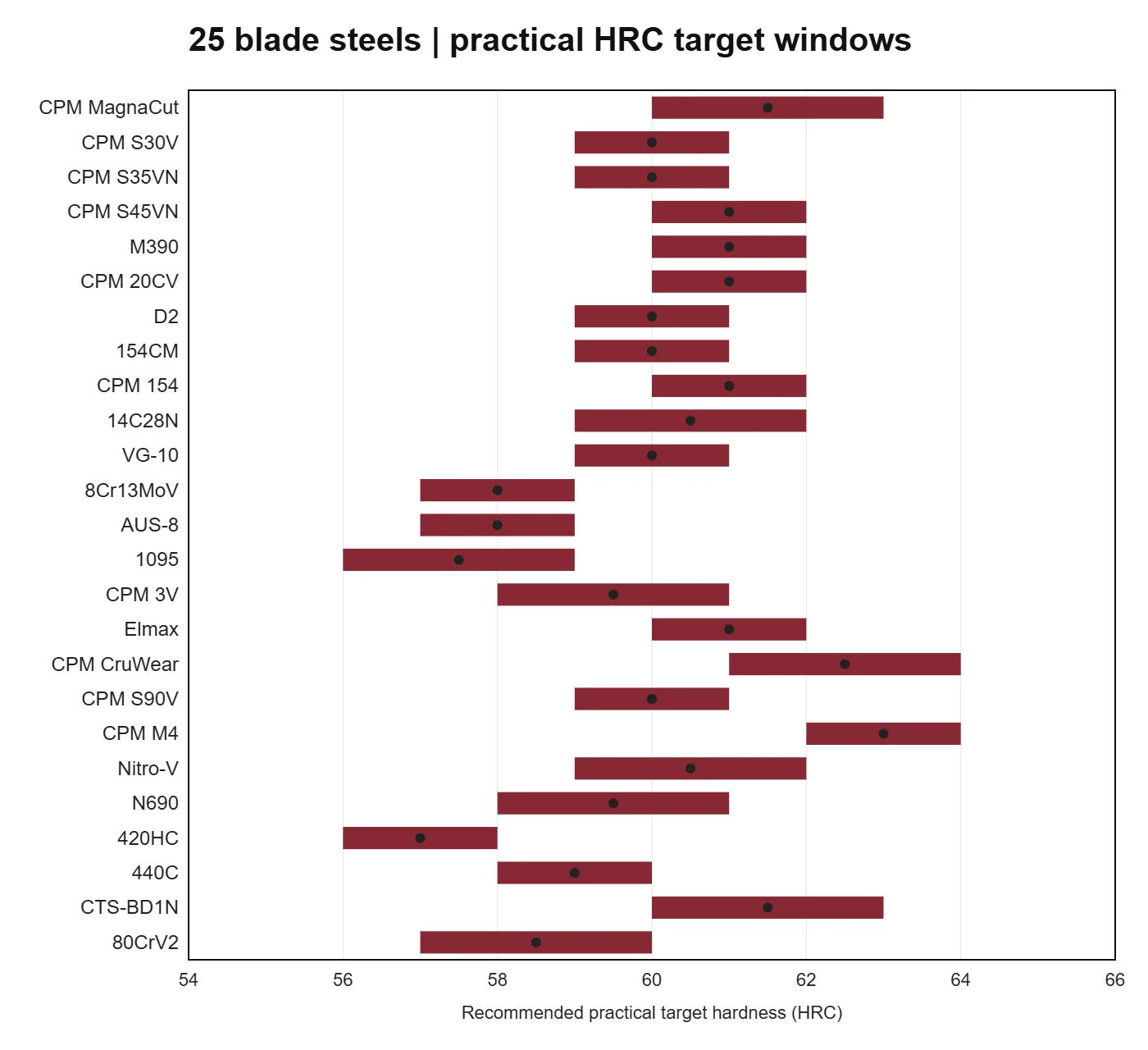
A practical guide to 25 modern knife steels, recommended HRC, real-world tradeoffs, and eight head-to-head matchups. Sharp Things, October 2026.
There is no single best blade steel. A knife that spends its life opening boxes needs something different from a hunting knife, a saltwater carry knife, or a heavy chopper. What matters is the complete package: steel chemistry, heat treatment, edge geometry, blade design, and how the owner actually uses the knife.
This guide covers the 25 most popular blade steels you will find across today’s production folding knives and fixed blades. The order is an editorial reference list, not an audited ranking of unit sales or a scientific popularity poll. Some long-established value steels appear beside newer enthusiast favorites.
First, what does HRC mean?
HRC is a measurement on the Rockwell C hardness scale. Higher HRC generally means more resistance to permanent deformation: a thin edge is less likely to roll or flatten. But hardness alone does not guarantee long-lasting sharpness. Wear resistance depends on carbide type and volume, while toughness is the ability to resist cracks and chips. Heat treatment also changes corrosion resistance and microstructure.
A lower HRC is not automatically a defect, and a higher HRC is not automatically brittle. For example, some correctly treated premium steels retain strong toughness at hardness levels that would be ill-suited to a different alloy. A chopping blade may deliberately be treated softer than a small slicer made from the same steel.
How to read our HRC figures: they are practical editorial target windows for typical knives, not mandatory factory specifications or limits of each alloy. Makers may intentionally choose different figures for blade size, geometry, and application. Check the finished knife manufacturer’s stated hardness where available.
What can happen at the cutting edge?
SOFTER EDGE
Rolls or flattens under load
BALANCED EDGE
Resists rolling and chipping
OVERSTRESSED EDGE
Chips when load exceeds toughness and geometry
The 25 most popular blade steels and their recommended HRC targets
| Steel | Target HRC | Steel family | Typical use |
|---|---|---|---|
| CPM MagnaCut | 60-63 | PM stainless | Balanced premium EDC, outdoor |
| CPM S30V | 59-61 | PM stainless | EDC, hunting |
| CPM S35VN | 59-61 | PM stainless | EDC, tactical |
| CPM S45VN | 60-62 | PM stainless | Premium folders |
| M390 | 60-62 | PM stainless | High-wear EDC |
| CPM 20CV | 60-62 | PM stainless | High-wear EDC |
| D2 | 59-61 | Tool steel (not stainless) | Value folders |
| 154CM | 59-61 | Stainless | Everyday utility |
| CPM 154 | 60-62 | PM stainless | Premium folders, fixed |
| 14C28N | 59-62 | Stainless | Value EDC, wet weather |
| VG-10 | 59-61 | Stainless | Japanese folders |
| 8Cr13MoV | 57-59 | Stainless | Entry EDC |
| AUS-8 | 57-59 | Stainless | Utility folders |
| 1095 | 56-59 | Carbon steel | Outdoor fixed blades |
| CPM 3V | 58-61 | Tool steel | Impact-heavy fixed blades |
| Elmax | 60-62 | PM stainless | Premium EDC |
| CPM CruWear | 61-64 | Tool steel | Hard-use EDC |
| CPM S90V | 59-61 | PM stainless | Wear-focused slicers |
| CPM M4 | 62-64 | Tool steel | Hard-use folders |
| Nitro-V | 59-62 | Stainless | EDC and outdoor |
| N690 | 58-61 | Stainless | Hunting, tactical |
| 420HC | 56-58 | Stainless | Traditional, utility |
| 440C | 58-60 | Stainless | General use |
| CTS-BD1N | 60-63 | Stainless | Utility EDC |
| 80CrV2 | 57-60 | Carbon steel | Bushcraft, chopping |
Note: these windows are rounded guidance. Differences of 1 to 2 HRC can reflect legitimate design choices, measurement variation, and heat-treatment routes. In particular, 14C28N can be produced over a wider manufacturer-recommended 55 to 62 HRC envelope, and the producer of CPM MagnaCut lists an aim hardness of 60 to 63 HRC, while some cutting-focused makers run it a little harder.
What the steel family labels mean:
- PM stainless: powder metallurgy stainless steel, made with a process that produces a finer, more uniform carbide distribution. Examples include CPM MagnaCut, CPM S30V, CPM S35VN and M390.
- Stainless: steel with enough chromium, in the right metallurgical condition, to give significant corrosion resistance. That is generally around 10.5% chromium or more, although composition alone doesn’t guarantee stainless behavior. Examples include 14C28N, AUS-8, 440C and 8Cr13MoV.
- Premium stainless: a general marketing term for higher-performance stainless steels. It doesn’t tell you how the steel was made. Elmax, VG-10, 154CM and M390 are often described this way.
Compare the steels in hand: the quickest way to feel the difference between MagnaCut, S30V, M390 and D2 is to pick them up side by side at Sharp Things OKC on N May Ave, open 9AM to 9PM every day, or browse our folding knives by blade steel online.
What separates the steels? Six useful categories
Balanced premium stainless: MagnaCut, S35VN, S45VN, Elmax
These options appeal to shoppers wanting a mixture of toughness, edge life and everyday corrosion resistance. MagnaCut is notable for combining very strong corrosion resistance with unusual toughness for its wear-resistance level, and our deeper look at what makes MagnaCut stand out covers why. S35VN and S45VN are sensible, established choices; Elmax offers a high-end powder-metallurgy alternative.
Wear-focused stainless: M390, 20CV, S90V
For slicing cardboard and other abrasive materials, these steels emphasize wear resistance and potentially long cutting life. The tradeoff may be more time on the stones and less tolerance for thin edges under side loading. M390 and 20CV are close counterparts; S90V is especially wear-focused.
Hard-use tool steels: 3V, CruWear, M4, D2
These steels do not offer the same rust protection as stainless options. 3V is strongly associated with tough fixed blades; CruWear offers a compelling hard-use EDC balance; M4 is respected for demanding cutting. D2 remains commonplace in value folders but can be more chip-prone than some finer-carbide steels in thin edges.
Value stainless: 14C28N, Nitro-V, 154CM, VG-10, N690, CTS-BD1N
Don’t dismiss these because the knife is affordable. 14C28N and Nitro-V are especially interesting when a sharp, stable edge and user-friendly maintenance matter more than extreme abrasion resistance. 154CM and VG-10 are proven midmarket options.
Entry-level and traditional stainless: 8Cr13MoV, AUS-8, 420HC, 440C
These steels remain useful because they tend to be affordable and accessible to sharpen. Their performance depends enormously on how the maker heat-treats the blade. A properly made lower-cost knife can be the right everyday tool.
Classic carbon steels: 1095 and 80CrV2
Common on bushcraft and survival fixed blades. They can be practical and durable with sensible heat treatment and geometry but need drying, oiling, and ongoing rust prevention.
Visual comparison: blade steel performance is a tradeoff
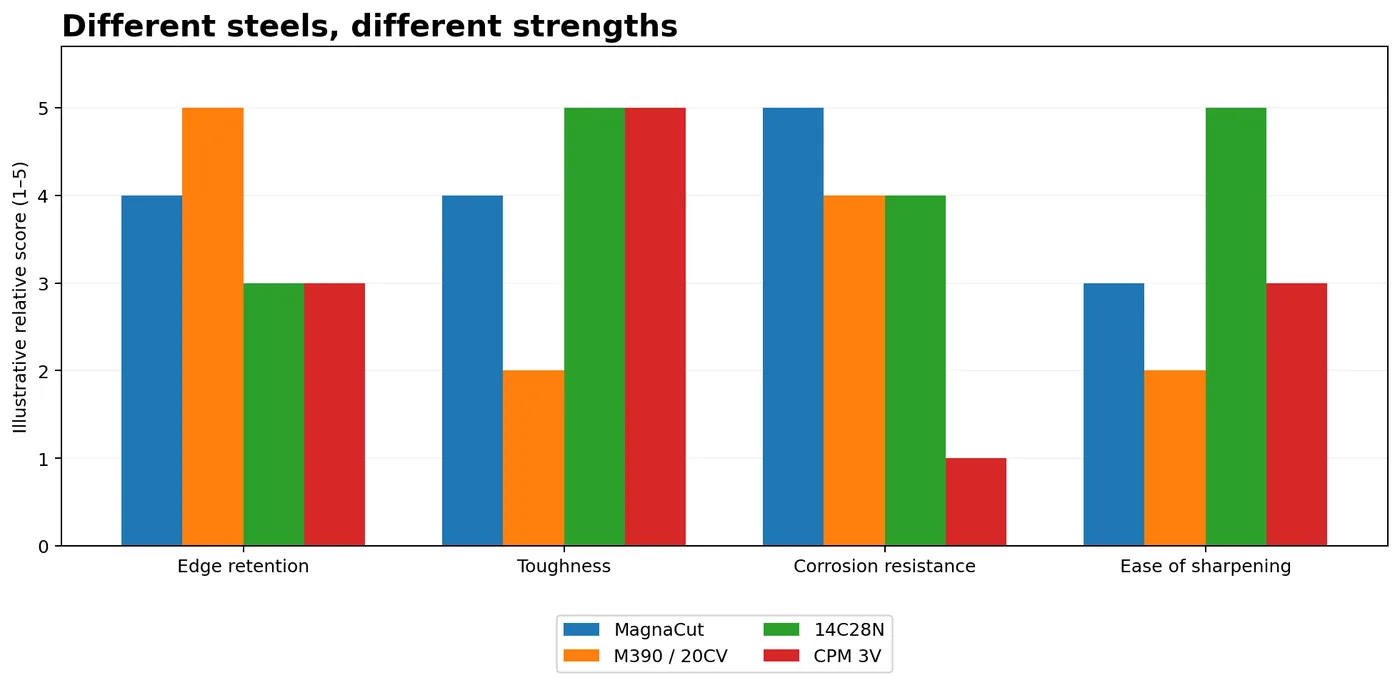
Chart disclaimer: scores are qualitative editorial illustrations on a 1 to 5 scale, not controlled head-to-head lab results. Actual rankings change with hardness, blade geometry, heat treatment, and test method. For “ease of sharpening”, higher means easier. If you are new to the harder steels, our guide to sharpening knives at the right angle will help.
Eight head-to-head blade steel comparisons
For a closer look at three of the most common EDC choices, see our MagnaCut vs S30V vs D2 comparison.
1. MagnaCut vs. M390
Choose MagnaCut if you want an outstanding corrosion and toughness balance in premium EDC or outdoors. Choose M390 if your priority is abrasion resistance and long slicing life. Neither one fixes poor edge geometry or heat treatment. Typical targets: MagnaCut 60 to 63 HRC, with some cutting-focused models run harder; M390 60 to 62 HRC.
2. M390 vs. CPM 20CV
These are near-comparable high-alloy stainless compositions from different producers. In the real world, geometry, sharpening and maker heat treatment will often matter more than the label. Both are commonly targeted around 60 to 62 HRC.
3. S30V vs. S35VN
S30V built its reputation on good wear resistance in mainstream premium folders. S35VN altered the recipe to improve toughness and workability relative to S30V, with some tradeoffs depending on the application. Both are sensible around 59 to 61 HRC.
4. S35VN vs. S45VN
S45VN refines the balance toward greater wear and corrosion performance, while S35VN remains a trusted all-rounder. If all else is equal, don’t make a buying decision from the steel stamp alone. Typical targets: S35VN 59 to 61 HRC; S45VN 60 to 62 HRC.
5. D2 vs. 14C28N
D2 brings impressive wear resistance for its cost but is not truly stainless, so care is important. 14C28N is stainless, relatively easy to maintain, and often more forgiving of thin, acute edges. Choose D2 for budget wear resistance or 14C28N for balanced day-to-day carry. Targets: D2 59 to 61 HRC; 14C28N 59 to 62 HRC.
6. CPM 3V vs. 1095
Both make useful fixed blades, but 3V is a premium powder-metallurgy tool steel famous for toughness and useful wear performance. 1095 is simpler, common and often easy to field-maintain. Both need corrosion care. Targets: 3V 58 to 61 HRC; 1095 56 to 59 HRC, often softer on larger choppers.
7. CruWear vs. CPM M4
CruWear often appeals to buyers wanting a tough, hard-wearing folder without chasing maximum abrasion resistance. M4 is particularly compelling for heavy cutting and wear resistance, but neither is stainless. Targets: CruWear 61 to 64 HRC; M4 62 to 64 HRC.
8. 14C28N vs. Nitro-V
Both are strong candidates for affordable, capable folders and smaller fixed blades. 14C28N is well established for edge stability and corrosion performance; Nitro-V is nitrogen-bearing and is popular for its balanced performance. Execution matters more than marketing. Targets: both roughly 59 to 62 HRC.
Why hardness can mislead shoppers
Imagine two knives stamped “60 HRC.” One can have a fine, stable cutting edge while another chips or dulls faster because their steels, heat treatments and sharpening angles differ. HRC measures one aspect of the finished blade, not the entire experience. A tougher blade can tolerate more demanding impact and edge geometry; a wear-resistant blade can keep cutting abrasive media longer. Think of HRC as a useful specification, not a final verdict.
What about powder metallurgy?
CPM and other powder-metallurgy (PM) processes help manufacturers produce a finer and more uniform distribution of carbides in many highly alloyed steels than traditional processing would permit. PM is not a guarantee that a knife is superior: the recipe, hardness, blade geometry and maker execution still matter. CPM 154 and conventional 154CM are a particularly clear example of closely related chemistry with different manufacturing routes.
Other steels worth knowing
CTS-204P (a close alternative to M390 and 20CV), AEB-L (fine edge stability), LC200N and Vanax (especially strong corrosion resistance), CPM S110V (very high wear resistance), CPM 4V and CPM 10V (specialized tool steels), K390 (wear-focused non-stainless), 12C27 (dependable stainless), 9Cr18MoV (value stainless), 52100 (carbon bearing steel), and Sleipner (tool steel) all deserve attention. Their absence from the main 25 is about scope, not a negative verdict.
A simple shopping decision guide
For a low-maintenance everyday folder, start with 14C28N, Nitro-V, S35VN or MagnaCut. For long abrasive cutting sessions, consider M390, 20CV or S90V. For a heavy fixed blade, compare 3V, 80CrV2, and 1095 with close attention to geometry. For humid or wet environments, prioritize a genuinely corrosion-resistant stainless steel and keep the whole knife clean. For a first knife or an easy-to-sharpen user, 420HC, AUS-8 and 14C28N can be practical choices.
Bottom line
The best steel is the one matched to your cutting tasks, maintenance habits, and budget, and treated properly by the knife maker. A well-designed knife with an honest heat treatment and stable edge will often outperform a more expensive knife chosen solely for its steel designation. At Sharp Things, comparing knives in person helps make those differences easier to understand.
Find your steel in a knife you’ll actually carry: Benchmade builds many of its folders and fixed blades in steels from this guide, including CPM MagnaCut, S30V, S45VN and M4. Shop the Benchmade collection at SharpThings.com, or visit us at 6610 N May Ave in Oklahoma City to compare them in hand.
FAQ: answers shoppers actually need
Is higher HRC always better?
No. Higher hardness can improve resistance to rolling, but the edge may lose toughness, depending on steel and treatment. The best range depends on use.
Does stainless mean rustproof?
No. Stainless steels resist corrosion to varying degrees; saltwater, sweat and neglected pivots can still cause trouble.
Why do two knives with the same steel perform differently?
Heat treatment, edge thickness, sharpening angle, surface finish and production consistency can all be different.
Can I tell HRC by touching or filing a blade?
Not accurately. Reliable values require proper hardness testing; the published number may be a batch or target range.
What steel should I buy?
Choose the use case first, then select a reputable maker with sound geometry and heat treatment. The steel name is only one part of the decision.
Sources and further reading
- Niagara Specialty Metals: CPM MagnaCut data sheet
- Alleima: 14C28N knife steel
- Alleima: 14C28N technical datasheet
Editorial note (October 2026): “Popular” describes prevalence and enthusiast recognition, not a quantified sales chart. HRC figures and performance guidance are approximate, application-dependent, and should not replace individual manufacturer specifications. The performance graphic is illustrative rather than laboratory-derived.