Blade Steel Comparison for EDC: MagnaCut, S30V, and D2

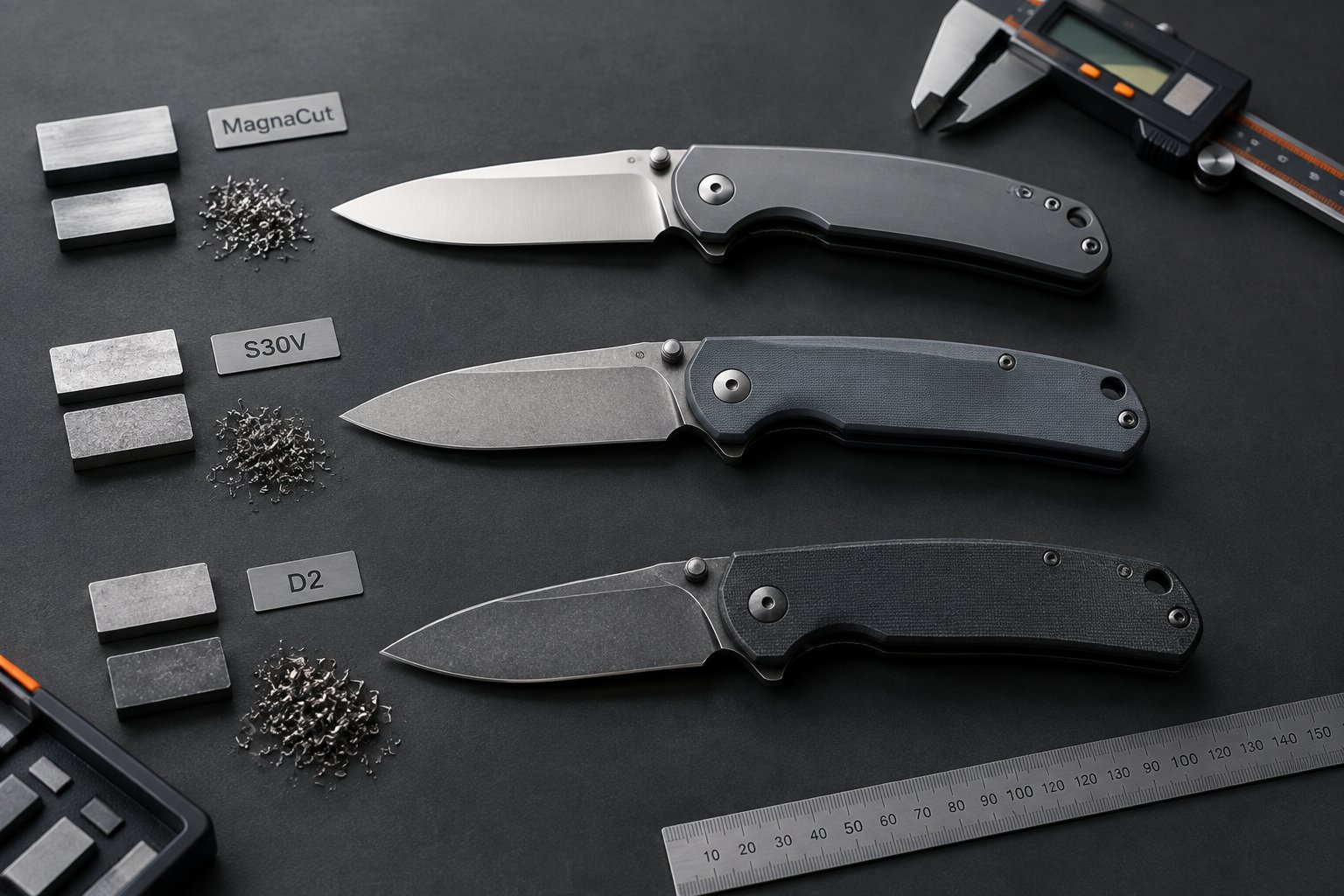
Every knife listing seems to promise the “best” steel, and after a while the names blur together. CPM MagnaCut, S30V, and D2 show up across everything from $60 folders to $300 flagships, and the price gap alone makes you wonder what you are actually paying for. A useful blade steel comparison for EDC starts with four traits: edge retention, toughness, corrosion resistance, and ease of sharpening.
No single steel wins all four categories, and that trade-off is the whole story behind why steel choice matters for a pocketknife you use every day. MagnaCut, S30V, and D2 each sit at a different point on that spectrum, and once you see where, the price tags start making sense.
This piece breaks down what separates these three steels in plain language, then matches each one to the kind of carry you actually do. By the end, you will know whether the “upgrade” steel is worth it for your pocket, or just worth it for someone else’s.
The Four Traits That Matter in Pocket Carry
Every blade steel is a compromise between four properties, and no manufacturer has cracked a steel that maxes out all of them at once. Once you understand these four traits, every spec sheet starts to make sense.
Edge Retention: How Long the Blade Keeps Cutting
Edge retention measures how long a blade stays sharp before it needs a touch-up. It comes down to two things: how hard the steel is heat-treated and how many hard carbides are packed into the metal.
Steels loaded with vanadium carbides, like S30V, resist abrasion better than simpler steels because those carbides are harder than the steel matrix around them. That is why a S30V blade can slice cardboard for weeks longer than a basic stainless before it feels dull.
Toughness: Resistance to Chips and Edge Damage
Toughness is a steel’s ability to flex or absorb impact without chipping or snapping at the edge. It works against edge retention in most alloys, because the same hard carbides that resist wear also make the steel more brittle.
This is where MagnaCut stands out. It was engineered specifically to keep high wear resistance without the brittleness that plagues older powder-metallurgy steels. Drop a blade point-first onto concrete, and toughness decides whether the tip survives.
Corrosion Resistance: What Sweat and Weather Can Do
Corrosion resistance depends mostly on chromium content, and it determines how a blade holds up against sweat, humidity, and saltwater. Steels with less than 13% chromium are not considered fully stainless, and D2 falls into that gray zone at around 12%.
That means a D2 blade can develop surface rust spots if it sits damp in a pocket after a humid day. MagnaCut, by contrast, was formulated with corrosion resistance as a design goal, not an afterthought, which helps explain why it tends to command a higher price.
Ease of Sharpening: The Cost of a Dull Edge
Ease of sharpening measures how much work it takes to restore an edge on standard stones. Steels with fewer, smaller carbides sharpen faster because the abrasive has less hard material to grind through.
D2 sharpens more slowly than basic stainless steels but faster than S30V, putting it in the middle of the pack. This trait matters more than most buyers expect:
- A steel with great edge retention but poor sharpenability can turn a 10-minute touch-up into a 45-minute session.
- Diamond stones cut through high-vanadium steels far faster than standard aluminum oxide stones.
- Beginners often abandon sharpening entirely if their first steel choice fights back too hard.
Once you know how these four traits pull against each other, it gets a lot easier to see why MagnaCut, S30V, and D2 each carry a different reputation among EDC carriers.
MagnaCut, S30V, and D2 at a Glance
MagnaCut leads on balance, S30V leads on track record, and D2 leads on value for the wear resistance it delivers. Here is what separates the three once you look past the marketing copy.
CPM MagnaCut: Balanced Performance at a Premium Price
CPM MagnaCut was developed by metallurgist Dr. Larrin Thomas, founder of Knife Steel Nerds, specifically to solve the toughness-versus-corrosion trade-off that older super steels never fully fixed. It pairs high chromium content for stain resistance with a carbide structure tuned for both wear resistance and toughness, a combination that’s rare among modern powder-metallurgy steels.
Knives running MagnaCut typically carry a premium price tag because the raw material and processing cost more than older alloys. Buyers get a steel that resists chipping, resists rust, and holds an edge close to S30V territory, without the brittleness some vanadium-heavy steels show at thin edge angles.
CPM S30V: The Proven Mainstream Premium Option
CPM S30V has been a benchmark premium steel since Chris Reeve Knives helped popularize it in the early 2000s. It uses vanadium carbides for strong wear resistance, and its two-decade track record across production knives gives buyers a known quantity.
The trade-off is toughness. S30V is more prone to micro-chipping at thin edge angles than MagnaCut, and it takes noticeably longer to sharpen because of its carbide density. It remains a safe, well-understood choice for buyers stepping up from budget steels for the first time.
D2: Strong Wear Resistance With More Care Required
D2 tool steel delivers wear resistance that rivals some stainless super steels, at a fraction of the cost. It contains around 12% chromium, which puts it in a “semi-stainless” category rather than fully rust-proof territory.
That means D2 needs more attention after wet use than MagnaCut or S30V. A quick wipe-down and light oil after a damp day helps prevent the surface spotting D2 is known for. Collectors often note that D2’s slightly coarser grain structure, compared to modern powder steels, is what gives it a distinctive, toothier edge that some cutting tasks actually favor.
A Plain-English EDC Steel Scorecard
Here is how the three stack up across the traits that matter for daily carry:
- Edge retention: S30V and MagnaCut are close, both ahead of D2 for sustained cutting sessions.
- Toughness: MagnaCut leads clearly, D2 is a strong second, S30V trails both.
- Corrosion resistance: MagnaCut leads, S30V is solidly stainless, D2 needs the most upkeep.
- Sharpening ease: D2 sharpens more easily than S30V, and MagnaCut falls between the two.
None of these steels is a bad choice. The right one depends entirely on what your pocket actually goes through in a given week.
Which Steel Fits Your Daily Use?
Your environment and cutting tasks should decide your steel pick before brand loyalty or hype ever enters the conversation. Here is how the three match up against real carry conditions.
For Humid, Wet, and Sweat-Heavy Carry
MagnaCut is the strongest pick if your knife spends time near water, sweat, or coastal air. Its higher chromium content resists the kind of surface staining that shows up on lower-chromium steels within days, not months.
S30V also performs well here since it qualifies as a true stainless steel. D2 is the one to watch closely; carrying it clipped against a sweaty pocket in July without occasional maintenance is how surface rust spots start.
For Cardboard, Rope, and Long Cutting Sessions
S30V and MagnaCut both hold an edge through heavy cardboard breakdown, rope cutting, or long food-prep sessions better than D2. Their vanadium carbide structure resists the abrasive wear that dulls a blade fast during repetitive cutting.
D2 still holds up respectably for this kind of task, and its wear resistance actually beats plenty of budget stainless steels used in sub-$60 folders. If your EDC knife handles box duty daily at a warehouse job, either premium steel earns its keep quickly.
For Users Who Sharpen at Home
D2 is the friendliest of the three on a standard stone setup, sharpening faster than S30V and slightly faster than MagnaCut in most side-by-side comparisons. If you sharpen with basic aluminum oxide stones instead of diamond plates, that difference is noticeable.
MagnaCut and S30V both reward diamond stones or ceramic rods, since standard abrasives struggle against their carbide content.
For a First Quality Folder on a Budget
D2 offers the best entry point into premium-feeling wear resistance without paying full super-steel prices. It shows up in well-regarded budget and mid-tier folders precisely because it punches above its price class.
A first-time buyer moving up from a $20 gas station knife will notice the difference in edge retention immediately with D2. Saving MagnaCut or S30V for a second knife, once you know your cutting habits, is a reasonable way to build a collection.
Why the Steel Stamp Is Not the Whole Knife
The steel name on a spec sheet tells only part of the story, because heat treatment and blade geometry can make or break how that steel performs. Two knives in the same steel can behave completely differently in hand.
Heat Treatment and Working Hardness
Heat treatment determines the final hardness, measured on the Rockwell C scale, and that number shifts everything about how a steel behaves. A MagnaCut blade run soft will underperform a well-treated S30V blade, even though MagnaCut has the better raw ceiling.
Reputable manufacturers publish their target hardness ranges, and it is worth checking before assuming steel name alone guarantees performance. Most first-time buyers never think to ask about this detail, but seasoned collectors check it before anything else.
Blade Geometry and Edge Angle
Geometry decides how a blade cuts just as much as the steel does. A thin, acute edge grind slices better but chips easier, while a thicker edge survives abuse but cuts less cleanly through soft material.
- A flat grind with a 15-degree edge angle cuts food and rope cleanly but is more prone to rolling on hard material.
- A slightly obtuse edge, closer to 20 degrees, sacrifices some slicing ease for real durability.
- Full flat grinds thin out faster behind the edge than hollow or saber grinds, changing feel over time.
What a Benchmade Bugout in S30V Shows
The Benchmade Bugout is a clean example of geometry maximizing a steel’s strengths. Its thin blade stock and flat grind make the S30V edge feel sharper and slicier than it would in a thicker blade.
That thin geometry is also why Bugout isn’t marketed as a pry-bar knife. Benchmade leaned into what S30V does well, clean slicing performance, instead of asking it to survive abuse a thicker, tougher blade would handle better.
What Premium Spyderco Para 3 Options Add
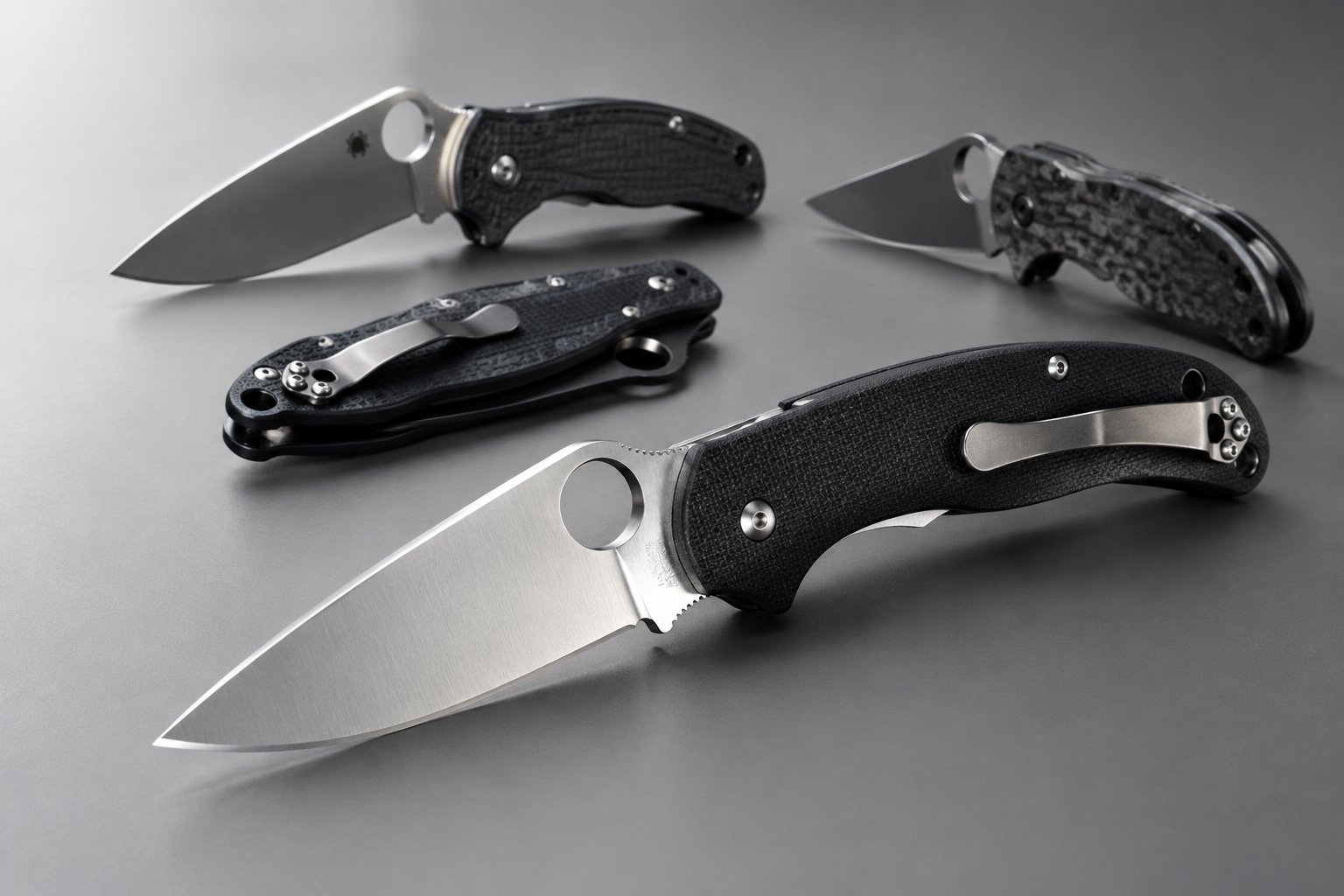
The Spyderco Para 3, offered in steels including CPM S45VN in premium runs, shows how a maker pairs geometry with a stainless super steel for an all-around EDC blade. Its full flat grind and moderate edge angle balance cutting performance with everyday durability.
Buyers choosing between a base steel Para 3 and a premium steel version are really choosing between upgraded corrosion resistance and edge retention, not a different knife shape. That distinction is exactly why steel choice deserves more attention than blade shape alone in most buying decisions.
Match the Blade to Your Carry Instead of the Hype
The best EDC steel matches what your knife actually does in a normal week, not the one with the most impressive spec sheet. MagnaCut earns its premium price for buyers who want balance across every trait without compromise.
S30V remains a smart pick for anyone who wants a proven stainless super steel with two decades of real-world use behind it. D2 delivers strong wear resistance for buyers who do not mind a little extra maintenance and want to spend less to get there.
Consider your actual routine before your next purchase:
- Carry near water or heavy sweat exposure: lean toward MagnaCut or S30V.
- Long daily cutting sessions on cardboard or rope: MagnaCut or S30V again earn their keep.
- Home sharpening on basic stones: D2 is the most forgiving of the three.
- First premium folder on a tighter budget: D2 delivers real performance without the top-tier price.
Steel choice is one piece of a bigger decision that includes handle ergonomics, lock type, and blade shape. Getting hands-on with a few options before buying is still the fastest way to know which trade-offs actually fit your pocket, which is exactly what a visit to Sharp Things OKC’s folding knife selection lets you do in person, or through same-day shipping if you order before the 3 pm cutoff.
Frequently Asked Questions
What Is the Best Blade Steel for EDC?
There is no single best steel, only the best match for your carry habits. MagnaCut suits buyers who want balance across edge retention, toughness, and corrosion resistance, while S30V and D2 fit specific priorities like proven performance or budget-friendly wear resistance.
Is S30V Better Than MagnaCut?
S30V isn’t better overall, but it performs nearly as well as MagnaCut at a lower price point in many knives. MagnaCut pulls ahead in toughness and corrosion resistance, making it the stronger all-around choice if budget allows.
Is D2 Steel Good Enough for an Everyday Carry Knife?
D2 works well for everyday carry, especially for buyers who do not mind occasional maintenance. Its wear resistance beats many budget stainless steels, though its lower chromium content means it needs a wipe-down after wet or humid days.
Does Higher Edge Retention Always Mean a Better Pocketknife?
Higher edge retention does not automatically mean a better knife for your situation. A steel with excellent edge retention but poor toughness or corrosion resistance can underperform a more balanced steel depending on how and where you carry it.
Which EDC Knife Steel Is Easiest to Sharpen?
D2 sharpens faster than S30V on standard stones, making it the easiest of the three to maintain at home. MagnaCut falls between the two, sharpening a bit easier than S30V but still benefiting from diamond stones or ceramic rods.
If you’d like to talk through which steel fits your carry, reach out to the shop before you order.