Best Olight Flashlights for EDC: Find Your Carry Light

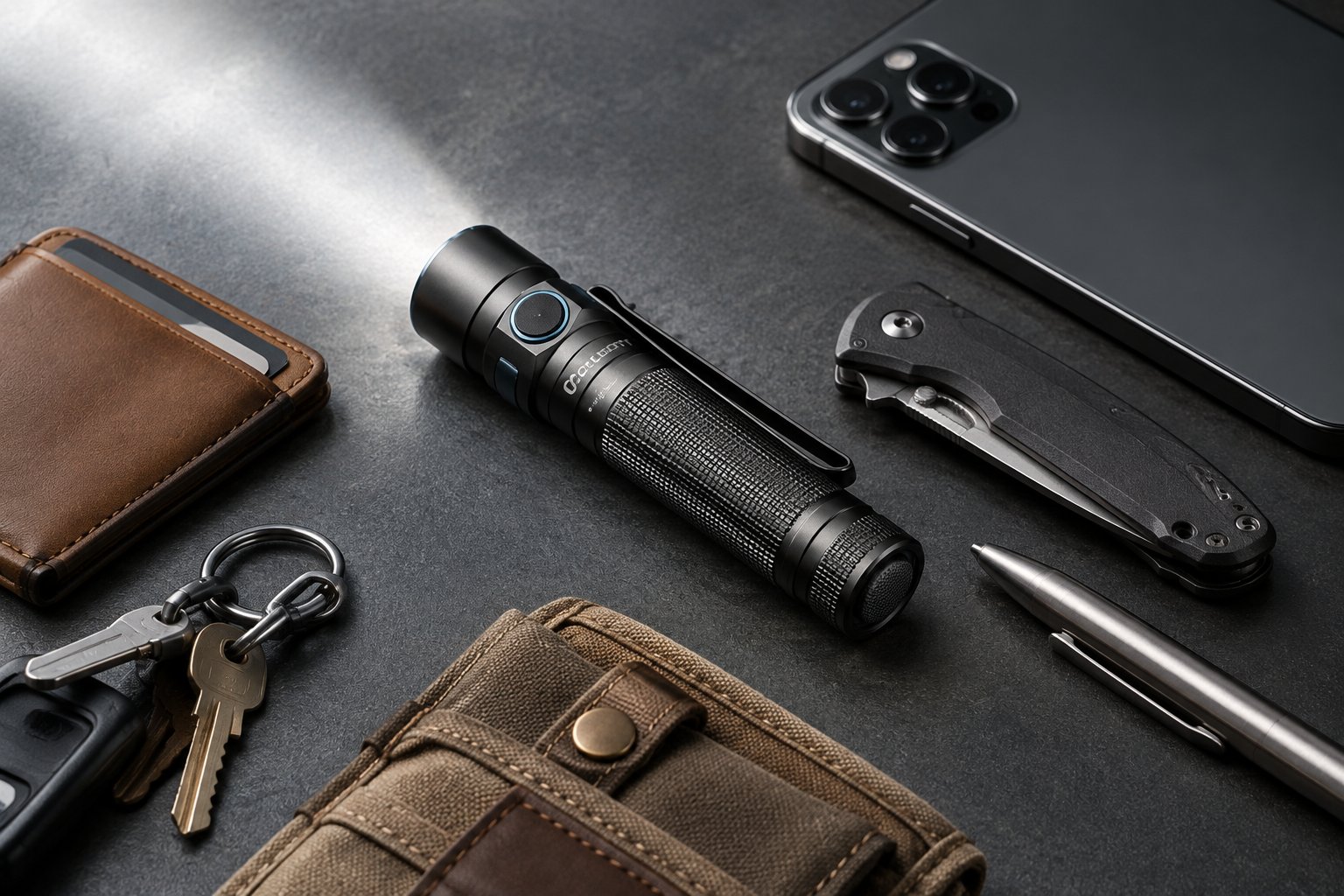
Picking the right EDC light out of Olight’s catalog gets confusing fast, since the brand makes dozens of models across several distinct series. Some are built to disappear in a front pocket, and others are built to run hard on a duty belt. The best Olight flashlights for EDC come down to how you carry them, not how many lumens the box claims.
A flat-body Arkfeld solves a different problem than a rugged Warrior, even though both wear the Olight name. Runtime numbers, switch placement, and clip design matter more day-to-day than peak output ever will. This guide walks through the models worth comparing and the specs that actually separate them.
Start With the Olight That Fits Your Carry
The right Olight EDC light starts with your pocket, not the spec sheet. A flashlight that outputs 2,000 lumens does nothing for you if it is too bulky to carry every day.
Olight built separate product lines around this exact problem. The Arkfeld series targets flat, low-profile carry. The Baton series aims for a middle ground between brightness and pocket size. Keychain models like the Oclip and i3T handle backup duty when a full-size light is not practical.
Arkfeld: Best for Flat-Pocket Everyday Carry
The Arkfeld line trades cylindrical shape for a flat, wallet-style body that rides against your leg without printing. This body style is why Olight’s own 2025 EDC flashlight ranking puts the ArkPro at the top of its list as “the most versatile.”
The Arkfeld Pro and newer ArkPro models add a UV light and a laser pointer alongside the main white LED. Per Olight’s own specs, the ArkPro’s main LED delivers 1,500 lumens with a 205-meter throw, putting it well ahead of most flat-body lights in its size class.
A first-time buyer sees the laser pointer as a gimmick. A collector knows it doubles as a presentation tool and a precise aiming reference in low light, which is a detail rarely mentioned on the product page.
Baton Series: Best Balance of Output and Pocket Size
The Baton series stays cylindrical, which keeps the beam pattern more traditional and the grip more familiar. The Baton 3 Pro Max sits near the top of this line, rated by Olight itself at 2,500 lumens on turbo with a 475-meter throw, powered by a 5000mAh battery.
Baton lights use Olight’s magnetic charging cable (MCC) system instead of a separate charging dock. You touch the cable to two pins on the light’s body, and it charges directly, no cover to remove.
- Baton 3 Pro: compact size, strong all-around output for daily tasks
- Baton 3 Pro Max: higher lumen ceiling, slightly larger body
- Baton Pro variants: older generation, still capable, often priced lower
That MCC system is convenient at a desk, but it changes how you think about backup power on longer trips away from an outlet.
Oclip and i3T: Best for Backup and Keychain Carry
The Oclip skips the pocket entirely and clips to a hat brim, collar, or bag strap for hands-free use.
The i3T fills a more traditional keychain role: small, twist-activated, and easy to forget you are carrying until you need it. The current i3T 2 EOS runs on a single AAA battery with a 200-lumen high and a 5-lumen low. Neither light replaces a primary EDC light, but both work as a backup when your main light is charging or left behind.
Once you have a flat-carry or keychain option covered, the next question is whether your daily tasks need more output than any of these lights can give you.
When a Warrior Light Makes More Sense
A Warrior light makes sense when your daily carry needs to double as a work or duty tool. The Warrior series trades slim profiles for higher lumen ceilings and tougher aluminum bodies.
These lights feature a side-mounted switch and a more aggressive grip texture than the Arkfeld or Baton lines. That ergonomic difference shows up the moment you need to operate the light one-handed in the dark.
Warrior Mini Models for Tactical-Style Pocket Carry
The Warrior Mini keeps a compact body while still delivering serious output for its size. Olight’s own specs put the Warrior Mini 3 at 1,750 lumens with a 240-meter throw, built around a dual-switch system: a quiet side switch for daily modes and a two-stage tactical tail switch for instant turbo or strobe access.
Mini-format Warriors still carry in a pocket, but the weight and grip diameter feel noticeably different from a Baton. That trade-off buys you a longer beam throw and a more secure hold under stress.
Full-Size Warrior Models for Work and Outdoor Use
Full-size Warrior models step up further in both output and body size, trading pocket subtlety for real throw and sustained runtime.
These models suit contractors, security staff, and anyone who spends real time outdoors after dark. The larger battery inside means longer sustained runtime at higher brightness levels than a compact EDC light can manage.
A full-size Warrior is a light you don’t forget you are carrying, which is exactly what you want when you need it ready at all times.
Weapon-Mount Compatibility and Dedicated Light Roles
Several Warrior models accept weapon mounts, turning the same light into a dedicated tool for a duty belt or a firearm rail. This dual-role design is one reason serious users keep a Warrior separate from a pocket EDC light.
A light built for weapon-mount duty needs recoil-resistant construction and a switch that is operable under gloves. That is a different engineering priority than a slim light meant to slide in and out of denim all day.
- Weapon-mountable Warrior models typically feature locking tail switches
- Mount compatibility varies by model year, so check the current rail spec before buying
- A dedicated mount light frees your primary EDC light from double duty
Choosing between a Baton and a Warrior really comes down to output needs, which raises the bigger question of how lumens and runtime compare across Olight’s lineup.
How Do Lumens, Runtime, and Beam Pattern Compare?
Lumens tell you peak brightness, not how long a light stays useful. A flashlight rated at 1,000 lumens on turbo mode often drops output within minutes to protect the LED and battery from heat.
Runtime and beam pattern matter as much as the peak number printed on the box. Comparing these three factors together gives a far more honest picture than chasing the highest lumen count alone.
Why Turbo Output Is Not the Same as Sustained Brightness
Turbo mode is a short burst, not a steady state. Most compact lights step down output automatically after a minute or two of turbo use to avoid overheating the LED driver.
A flashlight advertised at 2,000-plus lumens might settle into a sustained few hundred lumens for the bulk of its runtime. That stepped-down number matters more for how the light performs during an actual task, whether that’s checking a fuse box or walking a trail. Buyers new to flashlights often compare peak lumens between models and assume the higher number wins, when sustained output and throw distance, both of which Olight publishes for each model, tell a more useful story for everyday use.
Flood, Throw, and the Beam Pattern You Will Actually Use
Flood beams spread light wide for close-up tasks like reading a map or working under a sink. Throw beams focus light into a tight hotspot for spotting something at a distance.
Most Olight EDC models use a hybrid reflector that balances both, since a pure throw beam is a poor fit for pocket use. The Baton series leans slightly toward flood for general use, while some Warrior models add a deeper reflector for extended throw.
- Flood-heavy beam: best for close work, reading, tight spaces
- Throw-heavy beam: best for spotting distance, outdoor security checks
- Hybrid beam: most practical for daily carry across mixed tasks
Rechargeable Batteries, Charging Methods, and Runtime Claims
Nearly every current Olight EDC model runs on a rechargeable lithium battery rather than disposable cells. The MCC magnetic charging cable is the brand’s signature feature here, letting you snap a cable to two exposed pins instead of removing a battery.
This system is fast and convenient at a desk but leaves you without a spare-battery option on multi-day trips. Most Olight rechargeable EDC lights don’t accept swappable cells, which is worth knowing before a longer trip away from an outlet; some buyers keep a small power bank as backup for exactly this reason.
Runtime claims on product pages assume the lowest brightness setting, which stretches numbers into the hundreds of hours. Real-world runtime at a usable brightness level runs far shorter, and that gap catches new buyers by surprise.
Output and runtime numbers tell only part of the story once you try to carry and use the light day to day, which comes down to physical carry details.
Carry Details That Decide Whether You Use It
The features that decide whether you actually carry a light have little to do with lumens. Clip design, switch placement, and added modes like UV shape daily use more than any spec sheet number.
A flashlight with class-leading output does you no good sitting in a drawer because the clip snags on your pocket seam every time you sit down. These physical details deserve as much attention as brightness and runtime.
Pocket Clips, Magnetic Bases, and Hands-Free Placement
A deep-carry pocket clip keeps the light low enough that it does not print through fabric. Olight’s Baton and Arkfeld lines both use reversible clips, so left- and right-handed carriers can orient the light the same way.
Magnetic tail caps let you stick the light to a car frame, toolbox, or appliance for hands-free work. This feature appears on most current Olight EDC models and is genuinely useful for anyone working under a sink or hood.
Side Switches vs. Tail Switches
Side switches sit on the body near the head and control mode selection along with on/off. Tail switches sit at the very back and favor a simple, momentary-press action that many tactical users prefer under stress.
Baton and Arkfeld models typically use side switches for easier mode cycling during daily tasks. Warrior models lean on tail switches paired with a secondary side switch for mode changes, a layout built for gloved hands and fast activation.
When UV or a Laser Pointer Is Worth Carrying
A UV light earns its keep for spotting pet stains, checking currency, or scanning for fluorescent minerals on a hike. It is a genuinely practical add-on rather than a novelty feature on models like the ArkPro.
A laser pointer is more situational, useful for presentations or precise aiming reference in the dark, but rarely essential for daily carry. These extras add real versatility without adding much bulk to an already flat, pocket-friendly body.
Once you know which features you actually use, the remaining decision is matching a specific Olight model to your daily routine.
Match the Light to the Way You Carry
The right Olight model matches your routine before it matches any spec sheet number. Someone working a desk job with occasional outdoor errands needs a different light than someone doing property checks after dark.
A commuter who rides transit and works indoors most of the day gets the most value from a flat-carry Arkfeld or a compact Baton. The added UV feature on the ArkPro is a nice bonus for someone who travels and wants one light that covers a few small tasks.
Someone working trades, security, or regular outdoor shifts benefits more from a Warrior-class light. The larger battery and tougher body hold up to daily abuse that would wear down a slimmer EDC light within a year.
- Desk-and-errands carry: Arkfeld or Baton, prioritize slim profile and side switch
- Active outdoor or work carry: Warrior Mini or full-size Warrior, prioritize runtime and grip
- Backup or minimalist carry: Oclip or i3T, prioritize weight and simplicity
Matching output to actual habits, rather than chasing the highest lumen number on a shelf, is what makes a flashlight worth carrying every day.
Frequently Asked Questions
Which Olight flashlight is best for everyday pocket carry?
The Arkfeld line is the top pick for pocket carry because of its flat, wallet-style body that resists printing through fabric. The Baton series is a close second, offering a more traditional cylindrical shape with strong output in a compact size.
Is the Olight Arkfeld better than a Baton light for EDC?
The Arkfeld is better for flat, low-profile carry and multi-source features like UV and laser pointer. The Baton is better if you prefer a traditional flashlight shape and a slightly higher sustained beam throw.
Are Olight EDC flashlights rechargeable?
Nearly all current Olight EDC models use rechargeable lithium batteries with the brand’s magnetic MCC charging cable. Most of these models do not accept swappable disposable batteries, so a power bank is worth carrying on longer trips.
How many lumens do I need for an everyday carry flashlight?
300 to 600 lumens covers most daily tasks, like walking to a car or checking a dark room. Higher turbo ratings above 1,000 lumens matter more for outdoor or work use where longer throw and brighter bursts are needed.
Is a Warrior light too large for everyday carry?
Warrior Mini models still fit comfortably in a pocket, while full-size Warrior lights are noticeably larger and heavier. Full-size Warriors suit work or duty carry more than a slim front-pocket routine.
Are Olight lights with UV or laser features practical for EDC?
A UV light is genuinely useful for spotting stains, checking currency, or scanning outdoors, making it a practical daily feature. A laser pointer is more situational, useful for presentations or precise aiming but not essential for most daily carry needs.
Wrapping Up Your Olight EDC Decision
The Arkfeld line wins on flat, low-profile carry and multi-source features like UV and laser. The Baton series holds the middle ground between output and size, and the Warrior series steps up for anyone who needs weapon-mount compatibility or heavier daily use.
Runtime and beam pattern deserve as much attention as peak lumens, since sustained brightness is what actually gets you through a task. Clip design and switch placement decide whether a light stays in rotation or ends up in a drawer.
None of these trade-offs come through fully on a spec sheet or a product photo. Sharp Things OKC’s Olight lineup, including the Warrior Mini 3 and the Arkfeld series, lets you compare beam pattern, switch feel, and clip carry in hand. Stop by the store before deciding which Olight actually earns a spot in your pocket.