EDC Flashlight Buying Guide: Beam, Battery, and Carry

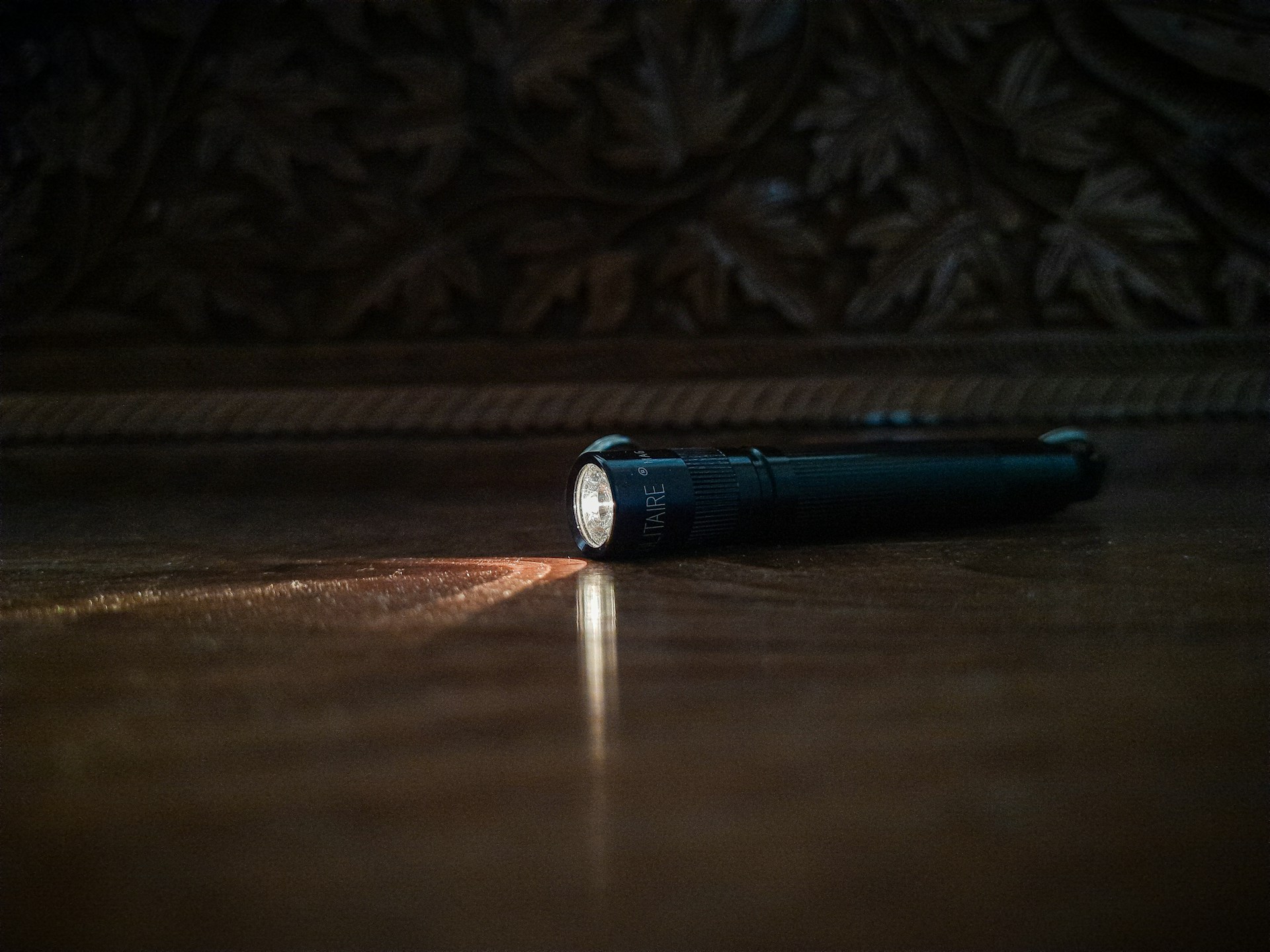
Most people shop for a pocket light by one number on the box: lumens. That number tells you only part of what you need to know.
This EDC flashlight buying guide explains the specs that matter for daily carry: lumens and candela, flood and throw, battery types, runtime, switches, and water ratings. It ends with quick picks by use case so you can match a light to your routine.
What Size and Carry Style Will You Actually Use?
The light you carry every day is the one that fits how you already carry things. A compact light that rides easily in a front pocket gets used far more than a bigger light left in a drawer because it’s a pain to carry.
Three carry formats cover most everyday carry lights: keychain lights, pocket tube lights, and flat lights. If you’re new to the idea of a daily kit, this primer on what EDC means and what goes in a kit puts the flashlight in context with the rest of your gear.
Keychain, Pocket Tube, and Flat Lights
A keychain light is the smallest practical option, built around a single small battery. It trades brightness and runtime for always being on you. NEBO’s Clip 500 is a good example of the clip-on keychain style.
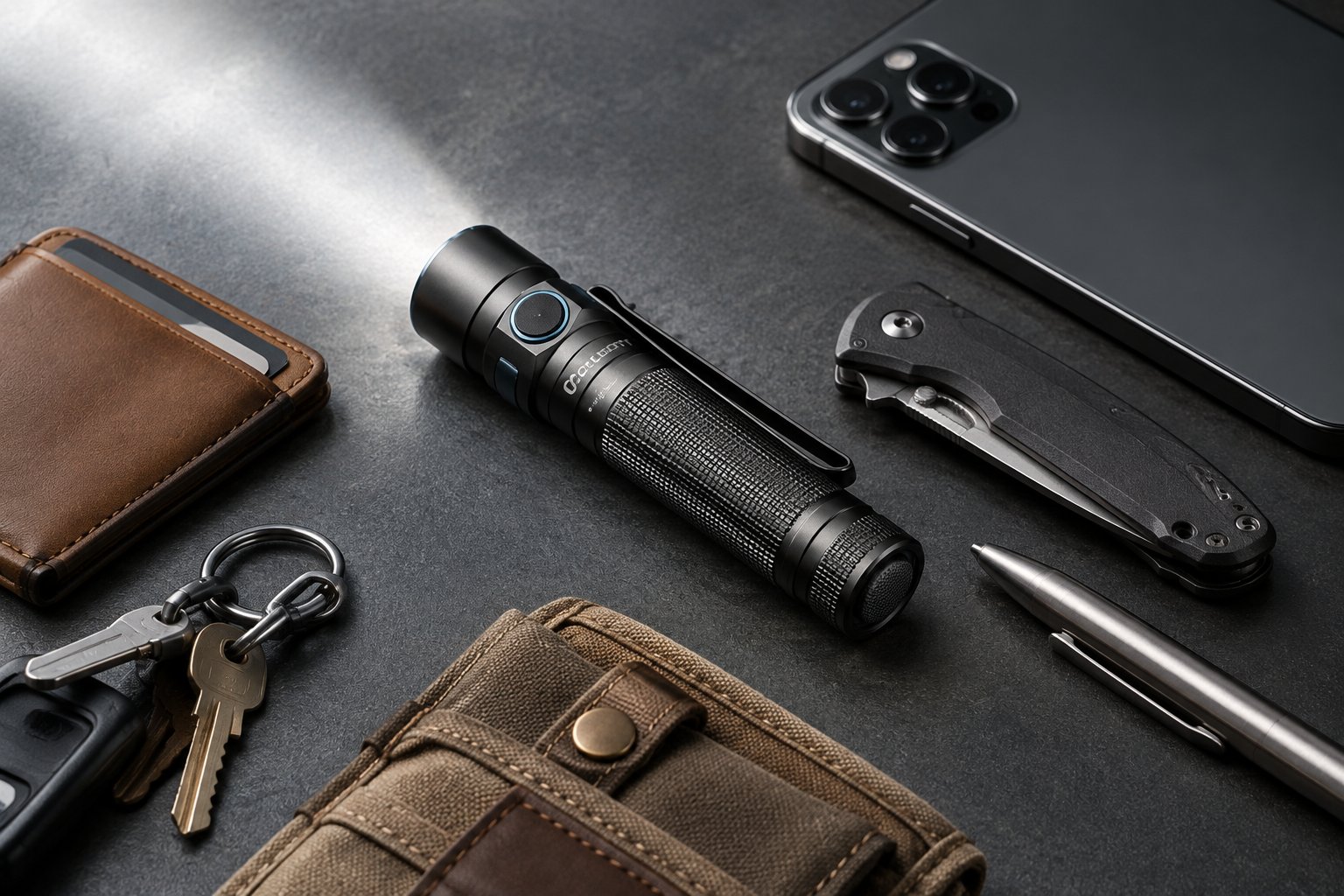
Pocket tube lights are the classic EDC shape: a cylinder you clip inside a pocket like a pen. Olight’s Baton series and NEBO’s Lumo 400+ fit here, and Maratac builds small tube lights around compact lithium cells such as the 14500 and 10440.
Flat lights are built to lie flush against your leg instead of printing as a round bulge. The Olight Arkfeld Pro is a well-known example: a flat body that packs a 1,300 lumen white light, a 365nm UV light, and a green laser into one unit, with a rotating selector to switch between them.
How Clips, Weight, and Pocket Placement Affect Carry
A deep-carry clip holds the light low in the pocket so only a little shows above the fabric. That matters if you want a light that doesn’t snag or print through the day.
Weight matters more than most buyers expect. A light that weighs a couple of ounces disappears in a pants pocket but can drag a shirt pocket down. Check the listed weight before you buy, and compare it to the knife or wallet you already carry.
Some clips are reversible or removable, letting a small light ride on a hat brim or bag strap for hands-free use. If you work under a sink or a car hood, that option earns its keep.
What Do Brightness and Beam Specs Tell You?
Lumens measure the total light a flashlight puts out. Candela measures how concentrated that light is at the brightest spot in the beam. You need both numbers to know how a light will behave.
Lumens vs. Candela: Total Light and Beam Intensity
Flashlight makers test these numbers under the ANSI/PLATO FL1 standard. Beam distance under that standard is the distance at which the light falls to 0.25 lux, roughly the light of a full moon, and it comes straight from the candela figure.
Here’s a real example. The Streamlight ProTac 2L-X spec sheet lists 500 lumens and 6,800 candela on high, for a 165-meter beam. On low, it drops to 40 lumens and 600 candela, for a 49-meter beam. Two lights with the same lumen rating can throw very different distances if one packs more of that light into a tight hotspot.
Flood vs. Throw: Match the Beam to Your Tasks
A flood beam spreads light wide and close. It’s what you want for finding keys in a bag, reading a label, or lighting up an engine bay.
A throw beam concentrates light into a narrow column that reaches farther. It’s what you want for checking the back of a yard or scanning a parking lot.
Most EDC lights blend the two. Lights with a deep reflector lean toward throw, while lights with a shallow reflector or a diffused lens lean toward flood. If the spec sheet lists high lumens but modest candela, expect a floody beam.
Peak Brightness vs. Sustained Output and Runtime
The lumen number on the box is almost always the peak, and many lights hold that peak for only a short time. A “turbo” or “boost” mode hits maximum output briefly, then steps down to protect the LED and battery from heat.
That step-down is by design. The Nitecore EDC29, for example, is rated at 6,500 lumens and uses what Nitecore calls an Advanced Temperature Regulation module to adjust output during long high-brightness runs.
The newest edition of the testing standard addresses this directly. The revised ANSI/PLATO FL 1-2025 standard adds a standardized test method for short-duration elevated brightness, the modes sold as “turbo” or “boost,” so brands report those numbers on the same basis.
Runtime figures tell you how long a mode lasts. The ProTac 2L-X lists about 3.25 hours on high with its rechargeable pack (2.75 hours on CR123A) and 30 hours on low with either. Decide whether you need short bursts of strong light or a dimmer beam that lasts a full shift.
Which Battery and Charging Setup Fits Your Routine?
The right battery setup depends on whether you value convenience, the freedom to swap cells, or long shelf life. Built-in rechargeables, standard disposable cells, and removable lithium-ion cells each solve a different problem.
Built-In Rechargeable Cells and USB-C Charging
A built-in rechargeable light uses a sealed lithium cell that you charge through a port or a magnetic cable. It keeps the light compact, and you never buy batteries. The Arkfeld Pro uses a built-in 1,500mAh lithium polymer battery, and the Nitecore EDC29 uses a built-in 2,500mAh cell that Nitecore says reaches full charge in about 1 hour and 15 minutes on a 5V/2A USB-C adapter.
The trade-off is simple: when a built-in battery dies, the light is out until you find a charger. If you charge your phone every night anyway, that’s rarely a problem.
AAA, AA, and CR123A: Replaceable Battery Options
A light that runs on disposable cells can be fed anywhere batteries are sold, which helps if you travel or don’t want to track charge levels. AAA and AA are the easiest to find. CR123A lithium cells pack more energy into a small size and store well for years, but cost more per cell.
Multi-fuel lights give you both options. The ProTac 2L-X runs on either Streamlight’s rechargeable pack or two CR123A batteries, so you can recharge day to day and keep spare CR123A cells in a bag for backup.
18650, 21700, 14500, and 10440: Capacity vs. Pocket Size
Lithium-ion cell names describe their size. An 18650 is about 18mm wide and 65mm long, and a 21700 is about 21mm by 70mm. Bigger cells store more energy, so the light can hold higher output longer, but the body gets thicker.
A 14500 is the same size as a AA, and a 10440 is the same size as a AAA, but both run at lithium-ion voltage. That gives a small light more punch without growing the body. Some lights accept either a AA or a 14500 in the same tube, which is why Maratac and similar small-format lights are popular with collectors. Only use a lithium-ion cell in a light whose maker says it supports one.
Which Controls and Durability Features Matter Day to Day?
A good interface gets you to the brightness you want without cycling through modes you don’t need. A good durability rating matches where you actually carry the light.
Side Switches, Tail Switches, and Simple Mode Access
A tail switch sits at the back of the light and works with a thumb press. Many support momentary-on, where the light stays lit only while you hold the button. Olight’s Warrior series is built around this kind of tactical tail switch.
A side switch sits along the body and usually handles mode changes, so you can step through brightness levels with one thumb. Some lights let you program the switch. Streamlight’s TEN-TAP system lets you choose between three programs on the ProTac 2L-X: high, strobe, low; high only; or low, high.
Moonlight, Mode Memory, and Strobe: Useful or Unnecessary?
Mode memory means the light comes back on at the last level you used. It saves time if you have a favorite everyday setting.
Moonlight mode is a very low-output setting for checking on a kid or finding the bathroom at night without lighting up the room. Strobe is a fast flashing pattern meant for signaling. Whether you need it depends on whether you’d actually use a signal flash.
When Does a Tactical Tail Switch Matter?
A tactical tail switch matters when you need instant, full-power light from a dead stop with one press. That’s useful for walking to your car at night, checking a noise outside, or any moment when you don’t want to click through low and medium first.
For general chores, a side switch with a low-first mode is often easier to live with. Pick the switch style that fits the job you’ll use it for most.
What IP Ratings Mean for Rain and Water Exposure
An IP rating describes how well a light resists dust and water. The first digit covers solids like dust, and the second covers water, so IPX7 means it was tested for water, but dust wasn’t rated.
IPX4 protects against splashing from any direction, which covers rain on a walk. IPX7 covers temporary submersion; Streamlight rates the ProTac 2L-X to survive 1 meter of water for 30 minutes. IP54 means some dust protection plus splash resistance. If your light lives in a tackle box or a kayak, look for IPX7 or IPX8.
Which Brands Make Good Comparisons?
Comparing lights by carry style and battery type makes the decision clearer than comparing lumen counts alone. Three brands show three different approaches.
Olight, NEBO, and Maratac by Carry Style
Olight leans into feature-dense designs. The Arkfeld Pro combines white light, UV, and a laser in a flat body, while the Baton and Warrior lines cover tube lights from pocket-sized to tactical. For a deeper look at the lineup, see this guide to the best Olight flashlights for EDC.
NEBO covers a wide range of everyday lights at friendly prices, from keychain clips and slim pocket lights to pen lights and larger work lights. NEBO’s pocket and keychain lineup is a good place to start if you want a reliable light without a big spend.
Maratac takes a simpler route: small tube lights built around compact lithium cells like the 14500 and 10440, often in metal bodies that appeal to collectors. These lights favor straightforward mechanics over extra modes.
Pick This If…
- Pick a keychain light if you want something that’s always on you and you mostly need light for keys, locks, and dark bags.
- Pick a slim pocket tube if you want a light in the 100 to 500 lumen range for daily chores, dog walks, and checking a car trunk.
- Pick a flat light if you hate pocket bulge or want extras like UV and a laser in one body.
- Pick a high-candela tube light if you need to see across a yard, a field, or a parking lot.
- Pick a tactical tail switch light if you want instant full power with one press.
- Pick AAA, AA, or CR123A if you want to avoid chargers or keep a light in a car or emergency kit for months.
- Pick a built-in rechargeable or 18650/21700 light if you use your light daily and already charge gear at night.
Frequently Asked Questions
What does EDC mean for a flashlight?
EDC stands for everyday carry: gear small and practical enough to keep on you every day. An EDC flashlight is compact, easy to run with one hand, and dependable enough that you grab it without thinking. Larger lights built for camping or job sites usually stay in a bag or truck instead of a pocket.
How many lumens do I need for a pocket flashlight?
For most daily tasks, 100 to 300 lumens is plenty: finding things in a bag, walking to the car, or checking under a seat. Higher outputs help when you’re searching a large area or lighting up distance, but they drain the battery fast and often step down after a short burst.
What is the difference between lumens and candela?
Lumens measure the total light a flashlight puts out, and candela measures how intense the brightest part of the beam is. High lumens with modest candela give a wide, flood-like beam. High candela gives a tighter beam that reaches farther, which is why candela predicts beam distance better than lumens do.
Is a rechargeable EDC flashlight better than one with disposable batteries?
A rechargeable light is usually cheaper to run and handier if you use it daily and charge gear at night. A light that takes AAA, AA, or CR123A cells is easier to keep running on trips or in an emergency kit, since you can buy cells almost anywhere. Multi-fuel lights let you do both.
Can I find a good EDC flashlight for under $100?
Yes. Many reliable pocket lights sit well under $100, including most NEBO pocket and keychain lights and several Olight models. Price tends to rise with body material, battery system, and extra features like UV or a laser, more than with basic reliability.
Order Before 3 PM, Ships Today
Ready to pick your pocket light? Browse the flashlight collection at Sharp Things OKC, from NEBO keychain lights to Olight flat and tactical lights. Orders placed before 3 PM usually ship the same day, or stop by the store on N May Ave to compare beams in your hand.