Are Lamson Knives Good? An Honest Look From Behind the Counter


Short answer: yes. If you are asking “are Lamson knives good,” the honest verdict is that they are well-made, full-tang kitchen knives from one of America’s oldest cutlery companies, backed by a lifetime guarantee and a free factory sharpening program. They are not the hardest or thinnest knives you can buy, and they ask a little more of you on care than some kitchen gear does. For most home cooks who want a good-looking knife that will still be in the drawer in twenty years, those tradeoffs are easy to live with.
Below is what you actually get in each Lamson line, where the knives come from, and the few things worth knowing before you pick one up.
A Company That Has Been Making Cutlery Since 1837
Lamson traces its history to 1837 and describes itself as one of America’s oldest cutlery companies. One detail from its past that we like: in 1869 the company presented a 62-piece dinner set to President Ulysses S. Grant, and pieces of it are displayed at the Smithsonian Institution.
Today the main factory and offices are in Westfield, Massachusetts, and the company runs a factory store in the historic mill town of Shelburne Falls. That long run matters for one practical reason. A company that has been around this long tends to stand behind what it sells, and Lamson does, which we cover further down.
Two Lines, Two Ways of Making a Blade
Most of the Lamson kitchen knives you will see on our shelves fall into two families. They look related, but they are built differently.
| Premier Forged | Vintage Precision
|
|
|---|---|---|
| How the blade is made | Hot-drop forged | Laser-cut from sheet steel |
| Steel | Grade 4116 stainless from Solingen, Germany | Lamson’s 420HC-LAM, American-made |
| Hardness | 58 HRC | 58 HRC |
| Construction | Full tang, integrated bolster, triple rivets | Full tang, two rivets |
| Handle options | Black G-10 (Midnight), acrylic (Fire), walnut | Walnut or black G-10 |
Sources: Lamson’s own product pages and its steel FAQ.
Premier Forged: the heavier, classic build
Premier Forged blades are heated and shaped with the traditional hot-drop forging method, then ice-hardened and tempered. The finished knife has a smooth front bolster where the blade meets the handle, a full tang running through the grip, and three rivets holding the scales on. An 8-inch Premier Forged chef’s knife with a Midnight G-10 handle is the one most people start with, and it gives you a good sense of the line: planted, balanced near the bolster and solid in the hand.
The steel, 4116, is a German high-carbon, high-chromium stainless. It is popular in kitchen cutlery because it resists rust well and sharpens easily on a home setup. If you want to see how it stacks up against other kitchen grades, our guide to kitchen knife steel grades breaks it down.
Vintage Precision: lighter and more traditional
Vintage blades are not stamped. Lamson is clear on this: they are laser-cut from steel that has been hammer-formed into flat stock, then heat-treated and tempered. That gives you a thinner, lighter knife without a heavy bolster, which many people find nimble for long prep sessions. The walnut handles with brass accents give the line its old-fashioned look.
Lamson currently lists the Vintage steel as its own 420HC-LAM, a high-carbon, high-chromium stainless made in the USA, hardened to 58 HRC.
See both lines side by side: the weight difference between a forged and a laser-cut Lamson is obvious the moment you pick them up, so stop by Sharp Things OKC at 6610 N May Ave, open 9AM to 9PM every day, or browse the full Lamson kitchen collection online.
Where Lamson Knives Are Made
Calling Lamson knives made in USA is fair, with some nuance. Lamson lists the USA as the country of origin on its product pages. Vintage Precision knives are made in the USA from American-made steel. Premier Forged knives are finished in Massachusetts, but the blade steel comes from Solingen, Germany, and Lamson notes that some handle woods and acrylics are imported. So the knives are American-made, using some imported materials on the forged line.
For a lot of buyers that mix is a plus: German steel with American finishing. If a fully domestic material chain is what you care about, the Vintage line is the closer fit.
What Lamson Gets Right
The backing is real. Lamson offers a lifetime guarantee covering manufacturing defects, with free repair or replacement. Its Sharp for Life program gives free professional resharpening by Lamson for as long as you own the knife; you pay to ship it in. Few kitchen knife makers offer both.
Full tangs across both lines. The steel runs the full length of the handle on Premier Forged and Vintage alike. That makes for a solid, well-balanced knife and handles that stay tight.
Handle choices that suit different kitchens. G-10 is a fiberglass-resin composite that shrugs off moisture and gives good grip when wet. The acrylic Fire handle adds color. Walnut, which Lamson infuses with food-safe cactus oil, is the warm, traditional pick.
Steel that is friendly to sharpen. At 58 HRC, both steels take an edge quickly on a stone or a rod. You will not spend an afternoon fighting a super-hard alloy.
The Honest Tradeoffs
No knife is perfect for everyone, and these are the points we bring up when customers ask.
Edge holding is good, not extreme. 58 HRC is a sensible middle ground. The edge is tough and easy to restore, but it will need honing more often than a very hard steel. A few strokes on a steel before you cook keeps it in shape. Lamson makes its own 10-inch honing steel for exactly this job.
No dishwasher, ever. Lamson says the dishwasher is never recommended for its knives, and putting standard-handled pieces through one voids the guarantee. Hand wash, dry right away, and you will be fine.
Walnut needs a little attention. Wood handles look great, but they want an occasional light coat of mineral oil so they do not dry out. If you know you will not do that, choose G-10.
Forged means heavier. Some cooks love the heft of a Premier Forged chef’s knife. Others find it tiring over a big prep job. That is a preference, not a flaw, and it is the main reason to handle both lines before choosing.
Which Lamson Line Fits Your Cooking
Pick Premier Forged if you like a weighty knife with a bolster, cook a lot of dense vegetables and proteins, and want the most low-maintenance handle, which is G-10.
Pick Vintage if you prefer a lighter, thinner blade, do a lot of quick slicing and trimming, and like the look of walnut and brass. The Vintage 8-inch chef’s knife is a good way to try the line before committing to a set.
Either way, a chef’s knife, a paring knife and a bread or slicing knife cover most kitchens. You can add from there.
Our Verdict: Are Lamson Knives Good for Home Cooks
Lamson knives are good, and in some ways they are better than their quiet reputation suggests. You get proper full-tang construction, a choice of forged German steel or laser-cut American steel, attractive handles, and a lifetime guarantee with free factory sharpening behind it. The tradeoffs are a mid-range hardness that likes regular honing, a strict no-dishwasher rule, and some weight on the forged line. For a home cook who wants a knife to keep for decades, that is a strong package.
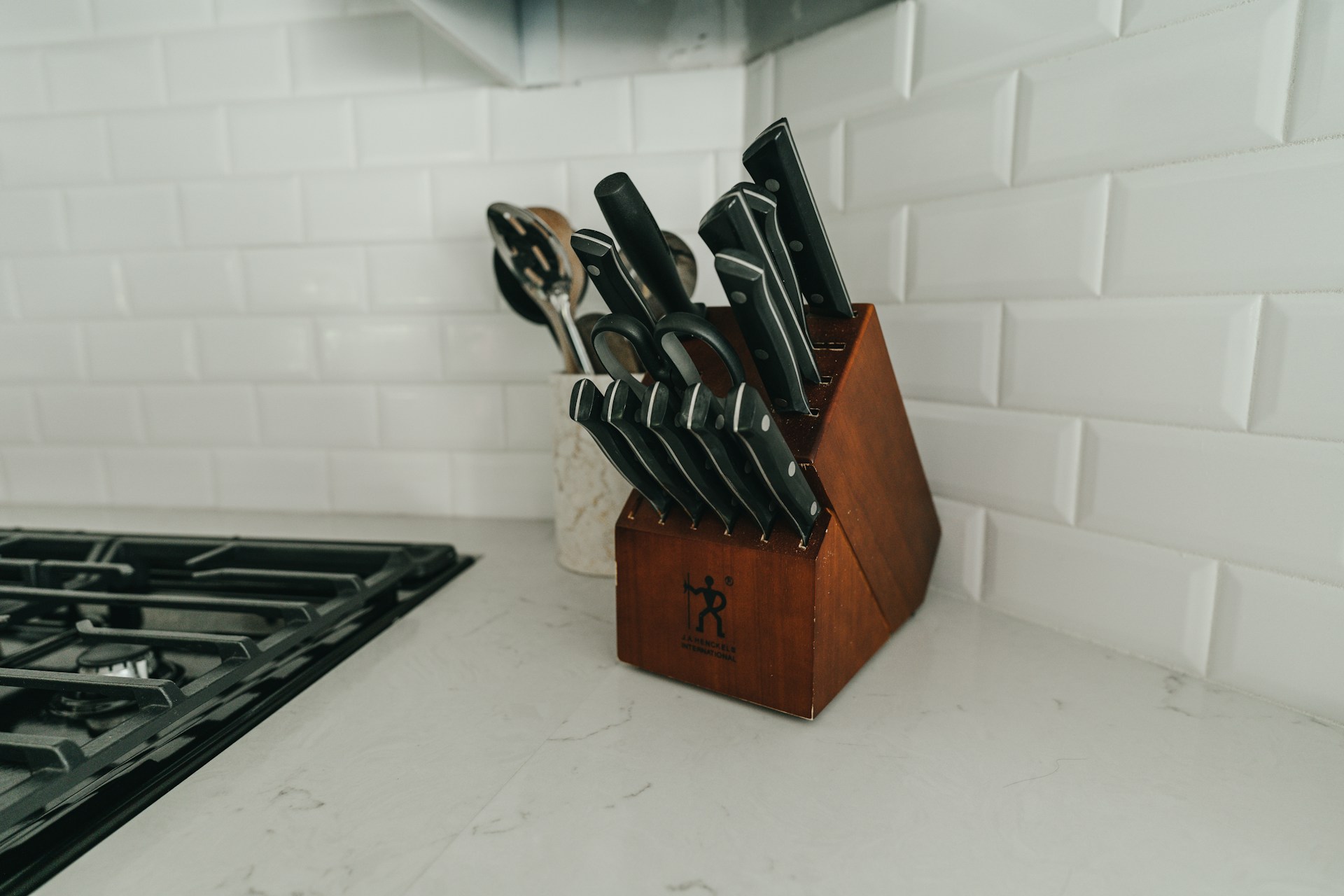
Pick your Lamson in person: come feel the balance of a Premier Forged and a Vintage chef’s knife at Sharp Things OKC on N May Ave in Oklahoma City, or order the Premier Forged 7-piece walnut block set at SharpThings.com, where orders received by 3pm generally ship the same business day whenever possible.
Frequently Asked Questions
Do Lamson knives come with a warranty?
Yes. Defects in materials or workmanship are covered for life, and Lamson will repair or replace the piece. To file a claim you fill in its online warranty form and ship the knife back with a printed copy. Running a standard-handled knife through the dishwasher voids that coverage.
How does Lamson’s Sharp for Life program work?
Lamson resharpens its knives for free for as long as you own them. You cover the shipping to send them in, and Lamson’s craftsmen put a fresh edge on the blade before sending it back.
What is the hardness of Lamson knives?
Lamson lists both Premier Forged and Vintage Precision blades at 58 on the Rockwell C scale. That is a balanced hardness that holds an edge well while staying easy to sharpen and resistant to chipping.
Are Lamson G-10 handles better than walnut?
G-10 is more practical because it ignores water and never needs oil. Walnut is warmer to the touch and more traditional to look at, but it needs an occasional coat of mineral oil. Both are covered by the same guarantee.
Does Lamson make stamped knives?
No. Lamson says it does not currently make stamped-blade knives. Its kitchen knives are either hot-drop forged, like Premier Forged, or laser-cut from formed steel, like Vintage Precision.