KA-BAR Knife Review: Is the USMC Classic Still Worth It?

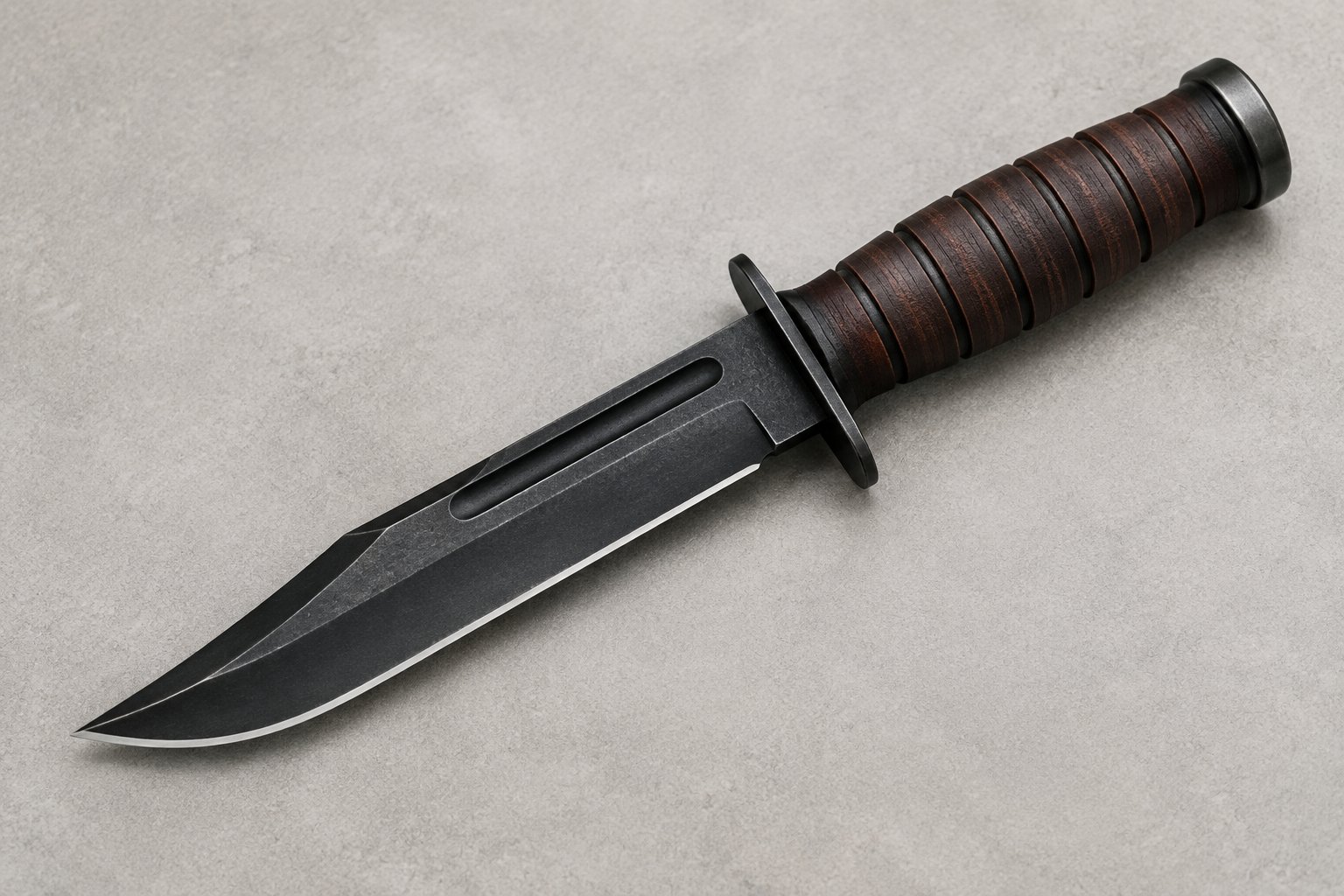
You have probably seen the KA-BAR USMC knife in a war movie, a surplus store, or your grandfather’s closet. It has carried Marines since 1942, and it still ships new today with the same 7-inch blade and stacked leather handle. This KA-BAR knife review looks at what that history actually earns you in 2026.
The short version: it is a tough, simple, field-sharpenable fixed blade with real trade-offs against modern steels and grinds. If you want a knife that survives abuse and forgives mistakes with a file and a stone, the KA-BAR still delivers, but it is not the sharpest tool for fine bushcraft work. The sections ahead cover exactly where it shines and where a newer design pulls ahead.
Who the Full-Size USMC KA-BAR Is For
The full-size USMC KA-BAR fits campers, collectors, and anyone who wants one rugged fixed blade instead of a drawer full of specialized ones. It is not a precision tool, and it does not pretend to be.
A Practical Verdict Before You Buy
Buy the KA-BAR 1217 if you want a knife that can baton firewood, dress game, and survive being dropped in a river. Skip it if your main use is detailed carving or you live somewhere humid and cannot commit to wiping down carbon steel. The pattern handles general survival and camp tasks well, which lines up with why the Marine Corps has trusted it for over 80 years.
The 1217 model runs 11.875 inches overall with a 7-inch blade, per KA-BAR’s own technical specs. That size puts it between a hunting knife and a short machete in terms of capability.
Fighting Knife Heritage vs. Modern Outdoor Use
The KA-BAR was built as a combat weapon first and a utility tool second. According to KA-BAR’s own company history, Union Cutlery Company (the original name of the business that became KA-BAR) worked with USMC Captain Howard America and USMC Colonel John Davis between 1942 and 1945 to submit a fixed-blade knife design to the Marine Corps for issue during World War II.
That heritage still shapes the blade geometry today. The clip point and blade guard exist for thrusting and grip retention in close combat, not for delicate wood shaving.
Modern buyers use the same shape for camp chores, and it works, but the design priorities have not changed since 1942. That gap between original intent and current use is exactly where the next question comes in: what does the classic design actually deliver on paper?
What the Classic Design Actually Delivers
The KA-BAR’s spec sheet has barely changed in 80 years, and that consistency is the point. Four elements define the knife: the steel, blade geometry, tang, and sheath.
1095 Cro-Van Steel: Tough, Sharpenable, and Rust-Prone
1095 Cro-Van is a high-carbon steel with added chromium and vanadium for extra toughness over plain 1095. It takes a keen edge fast and resists chipping under heavy chopping or batoning.
The trade-off is corrosion resistance. Carbon steel like this rusts if you leave it wet. A first-time buyer should know this rust risk up front:
- Wipe the blade dry after every use, even in humid air alone
- Apply a light coat of mineral oil or gun oil before storage
- Never sheath it wet, since the leather traps moisture against the steel
- Expect a gray patina over time, which is normal and actually protects the surface
Collectors often let that patina develop on purpose, since it signals a blade that has been used and cared for rather than left in a box.
7-Inch Clip Point, Guard, and Blade Geometry
The 7-inch clip point blade measures 0.165 inches thick and 1.188 inches wide, per KA-BAR’s listed specs. That thickness gives it enough mass for chopping without turning it into a machete.
The flat grind runs at a 20-degree edge angle, confirmed on the same spec sheet, a middle ground between a fine slicing edge and a durable utility edge. The clip point itself narrows the tip for controlled piercing cuts, a direct holdover from its combat design.
The steel guard separates the blade from the handle and keeps your hand from sliding forward during a hard thrust or chop. It is a small detail, but it is one reason this pattern still gets called a fighting knife instead of just a camp knife.
Tang Construction and the Stacked Leather Handle
The KA-BAR uses a full-length tang, meaning the steel runs the entire length of the handle in one piece.
That tang gets encased in stacked leather washers compressed under the guard and pommel, a construction style dating back to the original WWII knives. The leather handle gives a warm, grippy feel that many synthetic handles cannot match.
Here is a detail most first-time buyers miss: the tang is not a wide, flat slab like on many modern bushcraft knives. It tapers narrower than the blade spine, which affects durability under extreme lateral stress, a point worth remembering later in this review.
Leather Sheath, Carry, and Overall Size
The stock leather sheath is simple: a single retention strap and a belt loop, nothing more. It carries the knife securely for hiking and fieldwork but offers no drainage or synthetic reinforcement.
Overall length sits just under 12 inches, light enough for belt carry all day without becoming a burden. That balance of size and weight is a big part of why the pattern still holds up in hand despite its combat roots.
A leather sheath needs its own care routine, though, which becomes relevant once you start using the knife hard in wet conditions.
How the KA-BAR Performs in the Field
The KA-BAR handles heavy chores well but is poor at fine detail work, a direct result of its blade thickness and edge geometry. Field performance breaks down into four practical categories.
Camp Chores, Fire Prep, and Light Chopping
The 7-inch blade and forward weight make it capable of light chopping, splitting kindling, and batoning small logs. Its heft carries through a swing better than a lighter 4-inch fixed blade would.
For fire prep specifically, the spine is squared enough on most production runs to strike a ferro rod reliably. That is a small feature, but it matters if you are counting on this knife as your only fire-starting backup.
Edge Retention and Field Sharpening
1095 Cro-Van does not hold an edge as long as premium powder steels like CPM S30V or CPM 3V. It dulls faster under heavy use, but it comes back just as fast on a simple stone.
That trade-off favors people in the field without access to diamond plates or guided sharpening systems. A flat rock or basic pocket stone restores the edge in a few minutes, which is not true of harder modern steels.
Grip Security and Wet-Weather Handling
The stacked leather handle grips well when dry and gets slicker when soaked with water or blood. Kraton or Micarta handles found on newer KA-BAR variants resist this better in constant wet conditions.
Gloved use is manageable thanks to the handle’s moderate diameter, though the leather compresses slightly over years of use, changing the feel compared to a factory-fresh grip.
Maintenance Carbon Steel and Leather Require
Carbon steel and leather both need upkeep that stainless steel and synthetic handles do not. Skipping this maintenance is the fastest way to ruin a KA-BAR.
- Oil the blade after cleaning it, every single time it gets wet
- Condition the leather sheath and handle periodically with leather balm
- Store the knife outside its sheath for long-term storage to avoid trapped moisture
- Re-oil more often in coastal or humid climates than in dry inland regions
That maintenance list is manageable for most owners, but it points to a real question: where does this older pattern start to lose ground to knives built with modern materials?
Where the USMC Pattern Shows Its Age
The USMC KA-BAR’s biggest limitation isn’t the steel. It’s the tang width under extreme lateral stress, and that single design choice explains most complaints from serious hard-use buyers.
Why the Narrow Tang Concerns Hard Users
The tang tapers narrower than the spine to fit inside the stacked leather handle, a 1942 design choice meant to save steel and weight. Under normal use, this is a non-issue, but heavy prying or twisting can stress that narrower section more than a true full-width tang would.
Modern hard-use knives elsewhere in KA-BAR’s lineup, like the Becker BK7, use a thicker, uniform tang to address this concern, which shows the company recognizes the trade-off in the original 1942 design.
Fine Carving and Bushcraft Limitations
A 7-inch clip point with a thick 0.165-inch spine is not built for delicate carving or notching. Experienced bushcraft users often reach for something closer to a 4-inch drop point for detailed work, since that size and grind suit most bushcraft tasks better than the USMC pattern’s size.
The clip-point tip is also thinner and more fragile than a drop-point tip, making it a poor choice for repeated fine-detail cuts like feather sticking or notching for traps.
When a Modern Fixed Blade Makes More Sense
A shorter, drop-point fixed blade in stainless steel like CPM 154, or a sturdier full-width tang design, serves bushcraft and wet-climate carry better than the classic pattern. Buyers focused on precision work or minimal maintenance should look at these alternatives first.
That said, none of those trade-offs erase what the KA-BAR does well, which brings the review back to the core question every buyer actually needs answered.
A Classic Generalist for the Right Buyer
The KA-BAR earns its reputation as a generalist, not a specialist, and buyers should judge it on that basis. It chops, stabs, survives abuse, and sharpens easily in the field.
It falls short of specialized tools built for one job, whether that is fine carving, wet-climate carry, or maximum edge retention between sharpenings. That is a fair trade for a knife under most premium bushcraft price points that still carries genuine military pedigree.
Collectors value the KA-BAR for reasons beyond nostalgia: original military contract stamps, tang markings, and manufacturer variations create a real collecting subculture around this pattern. A first-time buyer usually does not know that detail, but it is part of why the knife holds resale value decades after purchase.
Frequently Asked Questions
Is a KA-BAR USMC Knife a Good Survival Knife?
Yes, for general survival use. The tough 1095 Cro-Van steel handles batoning, chopping, and rough field tasks well, and it sharpens easily with basic tools if you damage the edge.
Is the KA-BAR USMC Knife Full Tang?
Yes, the standard 1217 model uses full-length tang construction, with the steel running the entire length of the stacked leather handle. The tang tapers narrower than the blade spine, which is normal for the original WWII-era design.
Does 1095 Cro-Van Steel Rust Easily?
It rusts faster than stainless steel if left wet or unoiled, since it is a high-carbon steel with only modest corrosion resistance from its added chromium. Regular oiling and drying after use prevents most rust issues.
Is the Full-Size KA-BAR Better Than the Short Version?
The full-size 7-inch blade offers more reach and chopping power, while shorter KA-BAR variants trade some capability for lighter carry and better control on fine tasks. Which one wins depends on whether you prioritize chopping power or precision.
Are KA-BAR Knives Still Made in the USA?
Yes, KA-BAR manufactures its knives in Olean, New York, and the USMC 1217 model’s own listing confirms US manufacturing. Some specialty and licensed KA-BAR models are produced overseas, so check the specific model’s country of origin before you buy.
If you want to feel the tang thickness, blade balance, and leather handle in person before deciding, stop by Sharp Things OKC and handle a KA-BAR next to a few modern fixed-blade alternatives. Staff can walk you through steel options and even set up same-day shipping with a 3 pm cutoff if you would rather order online and get carrying sooner.