How Do Double Action OTF Knives Work? Inside the Mechanism

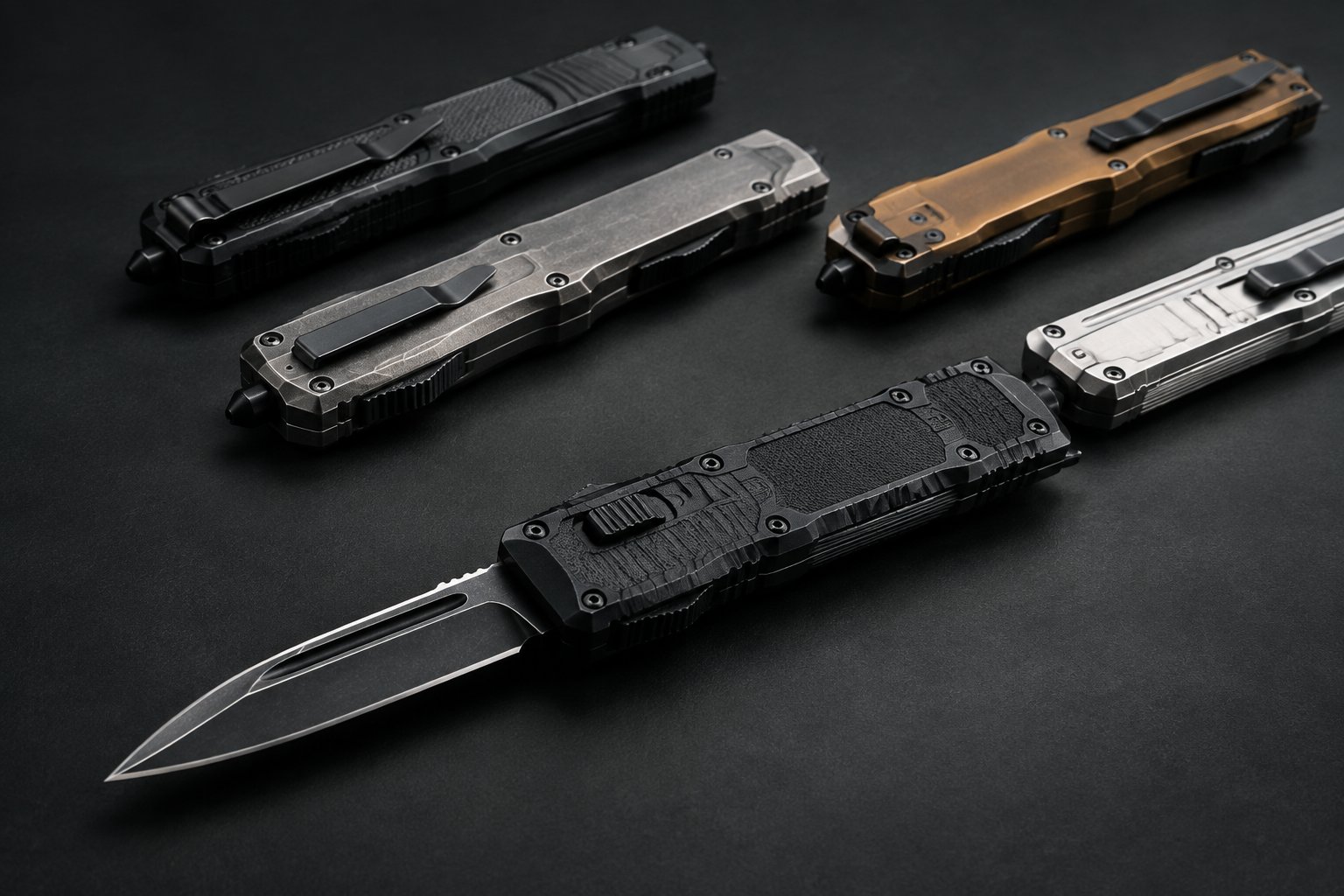
If you have held a double action OTF and felt that quick punch of the blade firing out, you already know the appeal. What is harder to see is what is actually happening inside the handle to make that happen twice, once on the way out and once on the way back in.
A double action OTF knife uses one slider to both fire the blade open and pull it back closed, without you ever touching the blade itself. That single detail separates it from a single-action OTF, and it is also where most questions about reliability and blade play come from.
This guide walks through the internal track, the spring assembly, and the locks that hold the blade in either position, so you know what you are actually paying for before you spend real money on an automatic.
What Happens When You Move the Slider
Moving the slider on a double action OTF drives an internal carriage that grabs the blade and pushes it through a fixed track. That single motion fires and resets the blade, which is the appeal of the double-action design.
From the Closed Position to Blade Deployment
Pushing the slider forward moves a carriage that has already locked onto the blade’s base, called the tang. As the carriage travels forward, it compresses a spring and carries the blade with it through a straight internal channel.
At a certain point in that travel, spring tension overcomes the resistance holding the blade back, and the blade snaps forward the rest of the way. This is why OTF deployment feels instant, even though your thumb isn’t doing all the work. Well-built mechanisms move the blade from closed to fully locked open in roughly a tenth of a second, fast enough that the eye barely registers the transition.
How the Retraction Cycle Resets the Mechanism
Pulling the slider back reverses the process without requiring a separate step. The carriage re-engages the blade tang, releases the open lock, and drags the blade back into the handle while loading the spring again for the next fire.
On a properly tuned knife, retraction should feel almost as smooth as deployment, with a light detent click confirming the blade is fully seated and locked closed. If retraction feels gritty or requires extra force, that usually points to debris in the track rather than a mechanical failure, which is worth understanding before assuming the worst about a new purchase.
Inside the Handle: The Parts That Control the Blade
Three systems work together inside every double-action OTF: a channel that guides the blade, a spring that stores energy, and a lock that holds the blade still at either end. Knowing what each one does makes it much easier to tell a well-made knife from a cheap one.
The Blade Channel, Track, and Carriage
The blade channel is a machined slot inside the handle that keeps the blade traveling in a straight line with no side-to-side wander during deployment. The carriage rides inside that channel and physically connects the slider to the blade’s tang.
Precision here separates a $60 import from a knife built by a maker like Microtech. Tighter tolerances between the carriage and channel mean less wasted motion, which translates to a crisper, more confident fire.
How the Spring Assembly Stores and Releases Energy
Most double-action OTFs rely on a spring-driven thrust mechanism built around the carriage rather than a single spring shared with the blade. A U.S. patent filed for exactly this kind of mechanism describes the core parts plainly: a handle, a button that slides axially along the handle, a blade with an integral tang, a locking mechanism within the tang, and a thrust mechanism that moves the blade between open and closed positions as the button travels each direction.
This differs from a single-action design, where the spring powers only the outward fire and never assists retraction. Double-action springs must be tuned to handle repeated compression in both directions without weakening early, which is part of why a well-made double-action OTF costs more than a basic single-action model.
How Open and Closed Locks Hold the Blade in Place
Every OTF needs two separate locks: one that holds the blade open for cutting, and one that holds it fully retracted so it cannot creep out in your pocket. These locks typically use a spring-loaded detent that drops into a notch on the blade tang, working alongside a stop pin and angled stop-plate surfaces that constrain the blade’s movement to a single straight path.
- Open lock: engages when the blade reaches full extension, preventing the edge from closing under lateral pressure during use.
- Closed lock: engages when the blade is fully retracted, keeping the tip from creeping forward accidentally while carried.
- Detent tension: adjustable on some higher-end models, affecting how firm the lock feels and how much force is needed to disengage it.
A knife that locks weakly in the open position is a real safety concern, not just an annoyance, and that is exactly why mechanism quality matters more with automatics than with manual folders.
Double-Action vs. Single-Action OTFs
The core difference comes down to one question: does the slider do all the work, or just half? Double-action slider motion both fires and retracts the blade, while single-action slider motion only fires it, leaving retraction to you.
Why One Slider Can Fire and Retract a Double-Action Blade
A double-action mechanism keeps the carriage permanently attached to the blade tang, so the same push-pull motion can drive the blade in either direction. Your thumb does not shove the blade through its entire travel; it only needs to move it far enough for spring bias to take over.
This is convenient for one-handed use, but it also means the spring assembly works harder over the knife’s life, since it is loaded on every open and every close. Brands that build reputations on double-action reliability, like Microtech, invest heavily in spring quality and carriage tolerances for exactly this reason.
Why Single-Action Designs Need Manual Recocking
A single-action OTF only uses spring force to fire the blade open. Retracting it means manually pulling a separate lever or the same slider all the way back until it locks, a design that traces back to the traditional Italian switchblades this style descends from.
Here is how the two typically compare for everyday buyers:
- Double action: one motion fires and retracts, faster in daily use, slightly more mechanical complexity inside the handle.
- Single action: simpler internals, often more affordable, but retraction requires a deliberate second step every time.
- Maintenance: single action designs have fewer moving parts to clean, while double action designs need consistent care in the track to stay smooth both directions.
No single design is more “correct”; the mechanical difference simply explains why double action models tend to carry a higher price tag. That price difference raises a fair question: how much wiggle in the blade is actually normal on a knife built this precisely?
What Blade Play and Reliability Really Mean
A small amount of side-to-side blade play is normal on nearly every OTF knife, including well-known models. It is a byproduct of the clearance needed for the blade to travel freely through the channel, not proof of a defective knife.
Why a Small Amount of Side-to-Side Movement Is Normal
OTF blades cannot fit the channel with zero clearance, because that much friction would slow deployment and cause premature wear. Some looseness is required so the blade can move freely without binding.
First-time buyers often assume any wobble means a bad knife. Collectors know better: minor play, especially side to side rather than up and down, is expected and does not affect cutting performance or edge retention.
How a Well-Tuned Microtech Ultratech Should Feel
The Microtech Ultratech is a common reference point for what a properly built double-action mechanism should feel like in hand. Deployment should feel crisp and immediate, with a solid, confident lockup and no mushy resistance partway through the stroke.
Retraction should feel similarly controlled, ending in a clean click rather than a loose, rattly stop. If an Ultratech-level knife ever feels gritty or inconsistent, it’s almost always a maintenance issue, not a sign the design itself is flawed.
Why Lint and Grit Cause Most Deployment Problems
Pocket lint, dust, and fine grit are the leading cause of OTF slowdown or misfires, far more often than a weakening spring. These particles work their way into the blade channel through pocket carry and gradually build up resistance against the carriage.
That single fact should change how you think about OTF ownership. A knife that starts firing unevenly rarely needs a new spring. It usually just needs a proper cleaning, which is a much easier fix than most new owners expect.
Keeping an OTF Mechanism Running Cleanly
Routine cleaning prevents almost every common OTF problem before it starts. A five-minute maintenance habit does more for long-term reliability than any upgrade part you could buy.
A Simple Cleaning Routine for Pocket-Carried OTFs
Compressed air is the first tool to reach for, since it clears loose lint and grit out of the blade channel without introducing anything new. Firing the blade open and closed a few times after blasting air through the mechanism helps work debris out through the channel opening.
A light, non-gumming lubricant applied sparingly to the track keeps the carriage moving smoothly. Daily-carry OTFs benefit from this kind of light service, especially if you carry them in a pocket with keys or coins that shed debris.
What Not to Put Inside the Handle
Heavy grease is one of the worst things you can put in an OTF mechanism, because it attracts dust and lint rather than repelling it. Thick lubricants also slow the spring action, which can make a fast, crisp knife feel sluggish within weeks.
Avoid these common mistakes:
- Heavy grease or motor oil: attracts debris and gums up the fine tolerances inside the channel.
- WD-40 as a long-term lubricant: fine as a cleaner, but it evaporates quickly and leaves the mechanism dry again.
- Disassembling the mechanism without cause: internal springs are under real tension, and reassembly errors cause more damage than the original problem.
When Inconsistent Firing Needs Professional Attention
A knife that continues firing slowly or unevenly after a proper cleaning may have a genuine mechanical issue rather than a debris problem. Worn detents, a weakened spring, or carriage misalignment fall into this category and are not something to force through repeated firing.
At that point, professional service protects both the knife and your fingers, since forcing a jammed OTF can cause unexpected deployment. It also raises the next practical question most owners eventually ask: how do you avoid buying a knife with these problems in the first place?
Choosing an OTF You Can Trust
The clearest sign of a trustworthy OTF is consistent, repeatable firing with no hesitation mid-stroke. That single test, done in person, tells you more about build quality than any spec sheet.
Reliable brands invest in tighter carriage tolerances, quality steels, and spring assemblies rated for years of repeated cycling. Models built around 154CM, D2, or Bohler steels, paired with a well-machined double-action mechanism, tend to hold up under real daily carry far better than budget imports that cut corners on internal fit.
Before buying, fire the blade open and closed several times in a row and pay attention to consistency rather than just the first impressive snap. A knife that fires clean once but hesitates on the third or fourth cycle is telling you something about its internal tolerances.
Handling a few different double-action OTFs side by side is the fastest way to feel this difference. Sharp Things OKC’s automatic knives selection has a working selection on hand so you can compare a tightly built mechanism against a sloppier one before spending money on either.
Questions before you buy? The staff can walk you through what to feel for.
Frequently Asked Questions
How does a double action OTF knife deploy and retract with one switch?
The slider stays connected to the blade through an internal carriage at all times. Pushing it forward fires the blade open, and pulling it back retracts the blade, using the same spring-loaded mechanism in both directions.
Is blade play normal on a double action OTF knife?
Yes, a small amount of side-to-side play is normal and expected on almost every OTF, including premium models. The blade channel needs slight clearance for smooth travel, so minor wobble does not indicate a defect.
Why does my OTF knife fire slowly or fail to lock open?
Lint and grit trapped in the blade channel cause most slow or inconsistent firing, not a failing spring. A thorough cleaning with compressed air and a light lubricant resolves most cases.
Can I replace the spring in a double action OTF knife myself?
It is possible but risky, since the springs are under real tension and reassembly mistakes can damage the mechanism or cause injury. Most owners are better off having a knife with a confirmed spring issue serviced professionally.
What is the difference between a double action and single action OTF?
A double-action OTF uses one slider motion to fire and retract the blade automatically. A single-action OTF only fires the blade automatically, and the user must manually pull it back to reset the mechanism.
How often should I clean a pocket-carried OTF knife?
Daily-carry OTFs benefit from a light cleaning on a regular basis, especially if carried alongside keys or coins that shed debris. Knives used less frequently can go longer between cleanings, but any hesitation in firing is a sign it is time.