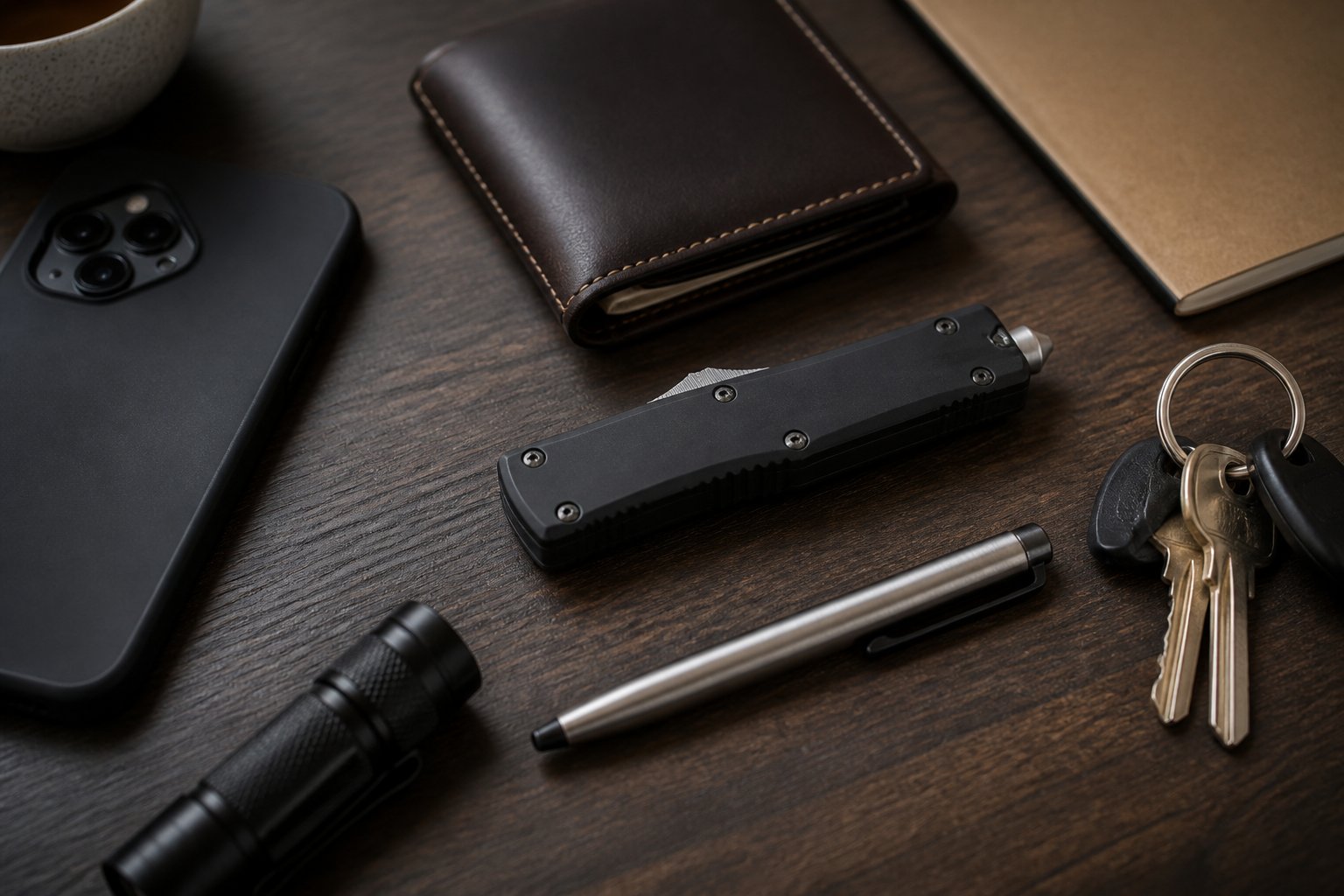
Switchblade vs. OTF Knife Difference Explained

If you keep seeing “switchblade” and “OTF” used for the same knife listing, you are not imagining things. The switchblade vs. OTF knife difference confuses even people who have carried a pocket knife for years. Both terms describe automatic knives, but they point to two different ways a blade leaves the handle.
An OTF knife is a type of switchblade, just one that fires straight out the front of the handle instead of pivoting out the side. That single mechanical detail changes how the knife feels in your hand, how it rides in your pocket, and in some states, how the law treats it.
This guide walks through where the terms overlap, where they split, and what that means for the knife you actually carry.
Is an OTF Knife a Switchblade?
Yes, an OTF knife is legally and mechanically a switchblade. It just deploys differently than the side-opening automatics most people picture when they hear that word.
What “Switchblade” Originally Meant
The word “switchblade” started as a catch-all term for any knife that opens with a button, not a specific blade shape or mechanism. Early automatics from the 1940s and 1950s opened from the side of the handle, which is why that image stuck in pop culture. Federal law cemented the term decades ago: the Switchblade Act of 1958, codified at 15 U.S.C. § 1241, defines a “switchblade knife” as any knife with a blade that opens automatically by hand pressure applied to a button or other device in the handle, or by operation of inertia, gravity, or both.
That broad wording matters more than most buyers realize. It never mentioned a specific opening direction, only automatic deployment.
Why OTF Knives Fall Under the Automatic-Knife Category
Out-the-front knives weren’t a mainstream category when that legal language was written, but they still fit the definition. The blade still opens automatically from a button or slider, so most state statutes treat OTFs the same as side-opening switchblades. A switchblade is simply one branch of the broader automatic knife family, and OTF knives are another branch of that same tree.
- Both mechanisms use an internal spring to fire the blade.
- Both are triggered by a button, lever, or slider, not manual force.
- Both fall under most state “automatic knife” or “switchblade” statutes.
Knowing that OTFs count as switchblades legally is only half the picture. The next question is what actually separates them once the blade is moving.
How the Two Automatic Mechanisms Differ
The core difference is direction of travel. Side-opening automatics swing the blade out of the handle like a folder; OTF knives push it straight out the front in a linear motion.
Side-Opening Automatics Pivot Out of the Handle
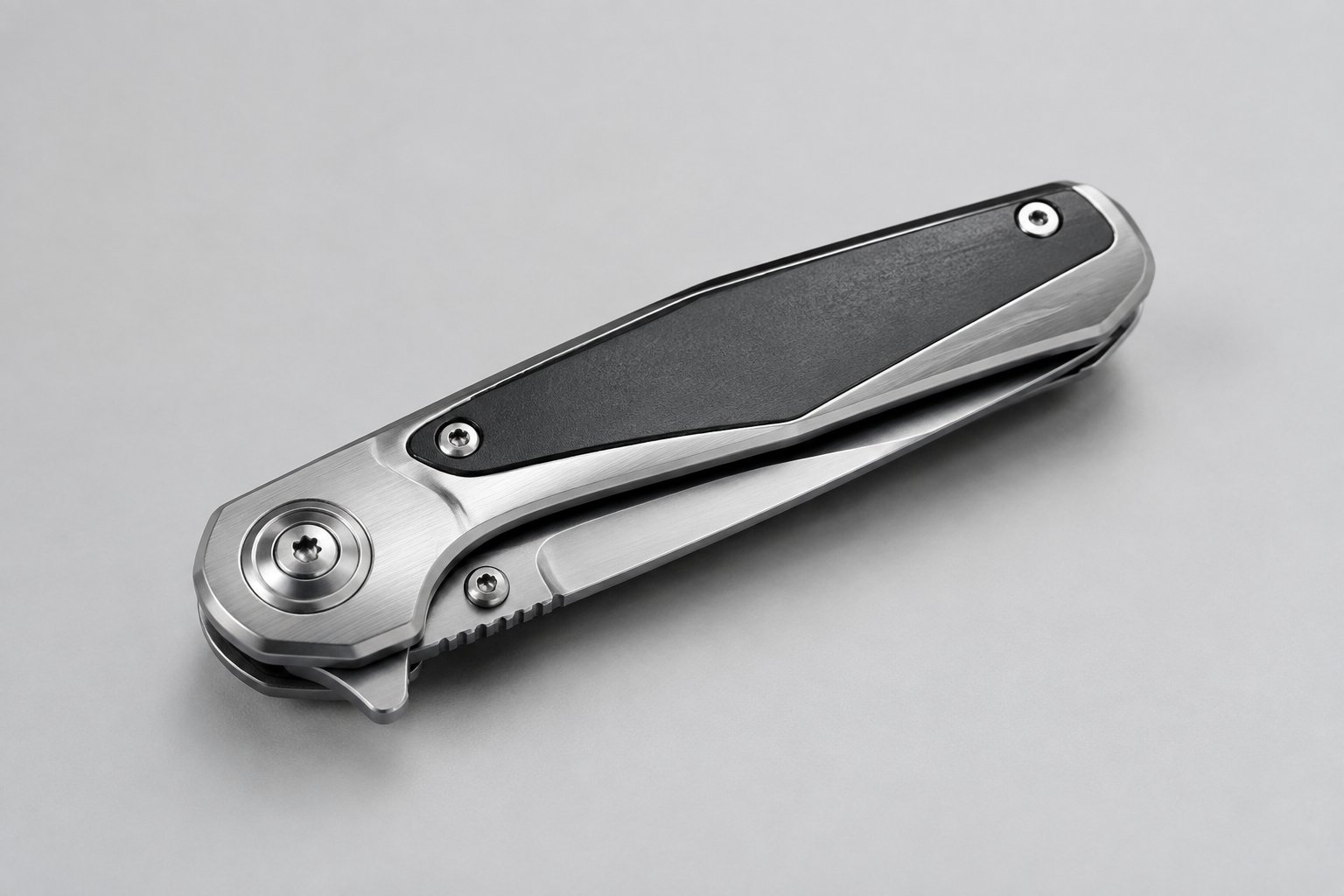
A side-opening automatic, sometimes called an OTS or “out-the-side” knife, uses a pivot pin just like a manual folder. Press the button, and an internal spring rotates the blade around that pivot until it locks open. Models like the classic Italian stiletto-style automatics use this exact setup, and it is what most people picture when they hear “switchblade.”
This mechanism has fewer moving parts than an OTF track system, which tends to make it simpler to maintain over time. The trade-off is a wider handle profile, since the blade needs room to swing during deployment.
OTF Blades Travel Straight Out the Front
An OTF knife sends the blade through a channel in the front of the handle, guided by an internal rail or track instead of a pivot. The spring-loaded slider or button pushes a carriage that the blade is mounted to, moving it in a straight line. A U.S. patent for this style of mechanism describes the core components plainly: a handle, a button that travels axially along it, a blade with an integral tang, and a thrust mechanism that drives the blade between open and closed positions as the button moves in each direction.
That design lets manufacturers build fully enclosed handles, which supports symmetrical dagger-style blades that would be awkward on a folder. The linear motion also changes how the knife handles in a thrust: a direct, front-facing extension feels more natural for puncturing packaging or tape than a pivoting blade does.
Single-Action vs. Double-Action OTF Knives
OTF knives split into two further types, and this distinction matters as much as the switchblade-vs-OTF question itself.
- Single-action OTF: the button fires the blade out, but you retract it by hand, pulling the slider back manually.
- Double-action OTF: the same slider both fires and retracts the blade automatically in both directions.
Double-action models like the Microtech Ultratech D/A feel more polished in daily use, since one motion handles opening and closing. Single-action designs are usually simpler mechanically, which can mean fewer parts to service over years of carry. Once you understand the mechanism, the real question becomes how each one actually feels when you carry and use it every day.
Deployment Feel, Carry Profile, and Maintenance
Side-opening automatics and OTF knives feel different from the moment you draw them, not just when the blade fires. That difference shows up in your pocket, in your grip, and in how often you clean the knife.
What Each Action Feels Like in Use
A side-opening automatic snaps open with a rotational click, similar to a manual folder but instantly. Once open, it settles into a familiar folding-knife grip, making it comfortable for general cutting tasks like breaking down boxes or trimming cord. An OTF knife fires with a sharper, more mechanical thunk as the blade shoots forward and locks.
That straight-line deployment gives OTF knives a more purposeful feel in the hand, which is part of why collectors gravitate toward them. It is also part of why OTFs get picked for scenarios that reward speed and a direct thrust motion.
Pocket Space, Blade Play, and Cleaning Needs
OTF handles tend to run longer and narrower than side-opening automatics, since the entire blade needs a channel to travel through. That shape can actually ride flatter in a pocket for some carriers, even though the overall length is longer. Side-opening autos are usually shorter and wider, closer to a standard folder’s footprint.
Here is a detail most first-time buyers miss: a small amount of side-to-side blade play in an OTF is normal, not a defect. The blade rides in a track with enough clearance to move freely, so a little wiggle is built in. What is not normal is a gritty or hesitant fire, which almost always means lint or dust in the track rather than a failing spring.
- OTF knives need more frequent air-blasting to clear pocket lint from the channel.
- Side-opening automatics need less internal cleaning but more attention to the pivot over time.
- Both mechanisms should avoid heavy grease, which attracts more debris than it prevents.
What Microtech Shows About Quality OTF Construction
Microtech built its reputation on tight OTF tolerances, and the Ultratech line is a common reference point for what a well-tuned double-action mechanism should feel like. The blade locks up with almost no vertical play, and the fire and retract strokes both feel controlled rather than loose. That level of fit comes from tighter internal tracks and better spring calibration, not a higher price tag alone.
Cheaper OTFs cut corners here first, which is why fit and lockup, not just steel, separate a $60 import from a $300 American-made OTF. Once you know what separates a well-built mechanism from a sloppy one, the next step is matching that mechanism to how you actually plan to carry.
Which Automatic Knife Fits Your Needs?
Your daily tasks matter more than brand loyalty when picking between these two mechanisms. Both are fast, but they reward different habits.
When a Side-Opening Automatic Makes More Sense
A side-opening automatic suits you if you want a knife that handles like a familiar folder once it is open. The wider handle gives your grip more surface area for detailed cutting, like trimming cord or opening packages with a slicing motion rather than a straight push. It also tends to have a shorter overall footprint, which some carriers prefer for a smaller pocket-clip profile.
Collectors who like classic Italian stiletto styling often lean toward side-opening automatics purely for the aesthetic, since that shape carries decades of design history.
When an OTF Is the Better Carry Option
An OTF knife fits you better if you want a knife built around a direct, forward stab motion rather than a slicing draw. The enclosed handle also means no exposed pivot to catch on pocket fabric, which matters if you carry loose in a pocket without a sheath.
- Choose a side-opening automatic for general slicing tasks and a shorter carry length.
- Choose an OTF for a direct thrust motion and a fully enclosed, symmetrical blade.
- Choose a double-action OTF specifically if you want one-handed open and close in every situation.
Either mechanism puts a legal switchblade in your pocket in most states, which raises the one question you cannot skip before ordering.
Check Automatic-Knife Laws Before You Carry
Automatic knife laws vary meaningfully by state, and that variation applies equally to side-opening and OTF designs. Verify your state and city rules before you order, since a knife that ships to your address isn’t automatically legal to carry there.
Why State and Local Rules Can Differ
Many states repealed their automatic knife restrictions over the past decade, but the pace and scope of those repeals were not uniform. Oklahoma, for example, repealed its statewide switchblade and dagger restrictions effective November 1, 2015, and the current text of 21 O.S. § 1272 no longer lists switchblades among prohibited items.
Other states still restrict blade length, cap automatics at a specific inch measurement, or ban them outright regardless of blade length, and the picture genuinely varies enough state to state that no single summary can substitute for checking your own statute directly.
City and county ordinances can also sit on top of state law and be stricter, so a knife that is legal statewide is not automatically legal in every municipality within that state.
Ownership, Ordering, and Carry Are Not Always Treated the Same
A state might allow you to own an automatic knife but restrict concealed carry of it in public, or limit open carry but not ownership. Some states also treat online ordering and shipment differently than in-person retail purchase, which matters if you are buying across state lines.
- Confirm whether your state treats OTFs and side-opening autos identically under its statute.
- Check whether concealed carry rules differ from open carry rules where you live.
- Look for any blade-length cap that applies specifically to automatics, not manual folders.
Sorting out the mechanism you want only matters once you know it is legal for you to carry.
Choose the Action You Will Carry With Confidence
Both switchblades and OTF knives put fast, reliable deployment in your pocket, and the mechanical difference between them comes down to direction of travel, not legal category. A side-opening automatic gives you a familiar folder grip with a shorter footprint. An OTF gives you a direct thrust motion and a fully enclosed handle built around dagger-style blades.
Fit and lockup quality matter more than which mechanism you pick, and brands like Microtech show what a tightly built OTF should feel like in hand. A little side-to-side blade play is normal on an OTF; a gritty, hesitant fire usually means it needs cleaning, not replacing.
If you are still weighing a switchblade against an OTF knife, handling both in person tells you more than any spec sheet. Stop by Sharp Things OKC’s automatic knives selection to fire a few side-opening and OTF models back to back, and get a straight answer on what is legal to carry in Oklahoma City before you buy.
Same-day shipping is available for orders placed before the 3 pm cutoff if you would rather order online and compare mechanisms at home.
Frequently Asked Questions
Is an OTF Knife Considered a Switchblade?
Yes, an OTF knife is a switchblade under most state and federal definitions, since both open automatically from a button or slider. The only real difference is direction: OTFs fire straight out the front, while classic switchblades pivot out the side.
Are OTF Knives Legal to Carry?
OTF knives are legal to own and carry in most states, but rules vary by location and sometimes by city ordinance. Check your state and local laws before ordering, since ownership, open carry, and concealed carry aren’t always treated the same way.
Is a Side-Opening Automatic More Reliable Than an OTF Knife?
Side-opening automatics have fewer moving parts, which can mean simpler long-term maintenance. A well-built OTF from a quality manufacturer is just as reliable in daily use, as long as the internal track stays free of lint and grit.
What Is the Difference Between a Single-Action and Double-Action OTF?
A single-action OTF fires the blade forward with a button press, but you retract it by hand. A double-action OTF uses the same slider to both fire and retract the blade automatically in each direction.
Are OTF Knives Good for Everyday Carry?
OTF knives work well for everyday carry if you want fast, one-handed deployment and a fully enclosed handle. They suit tasks that favor a direct thrust motion, while side-opening automatics may feel more natural for general slicing and box-cutting tasks.