Push Dagger vs. Fixed Blade Knife: Carry Differences

If you carry for personal protection, the push dagger vs fixed blade knife question comes down to grip geometry, not just blade length. A push dagger locks into a closed fist with a T-shaped handle, while a standard fixed blade rides in-line with your forearm for reach and everyday cutting. Both are capable tools, but they solve different problems.
The right choice depends on whether you need a dedicated close-range tool or a knife that also earns its keep opening boxes and cutting cordage. Push daggers trade versatility for retention and speed. Fixed blades trade some instant-grip security for reach, utility, and broader legal acceptance.
This comparison breaks down handle mechanics, concealment, and the legal quirks that catch first-time buyers off guard.
The Carry Decision at a Glance
A push dagger is a compact, single-purpose defensive tool, while a fixed blade knife is a general-purpose cutting tool that can also defend you. That single difference shapes everything else about how each one is carried, deployed, and performs.
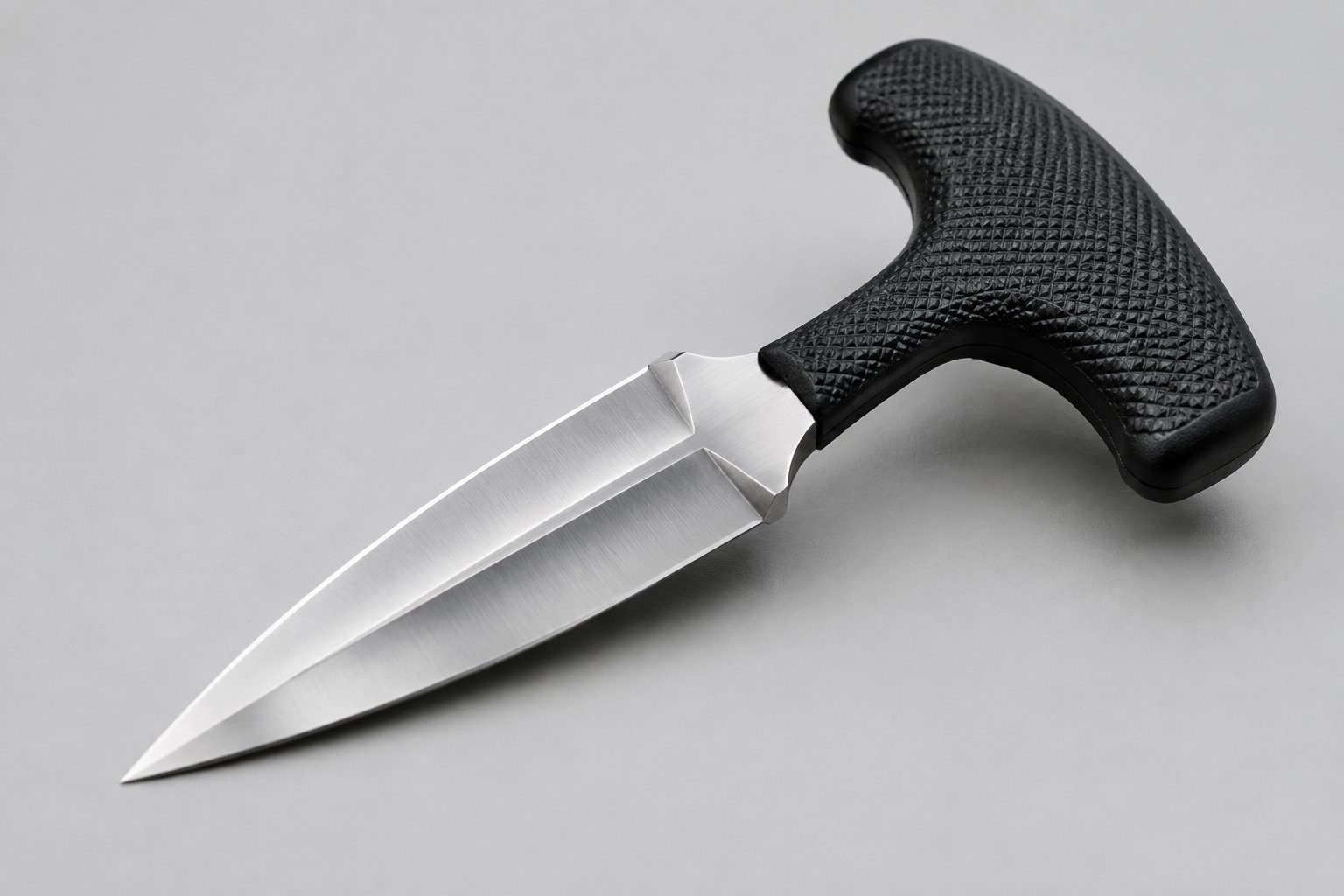
A push dagger is a short fixed blade built around a T-shaped handle. The grip sits perpendicular to the blade instead of running parallel to it like a traditional knife. That 90-degree twist defines the tool.
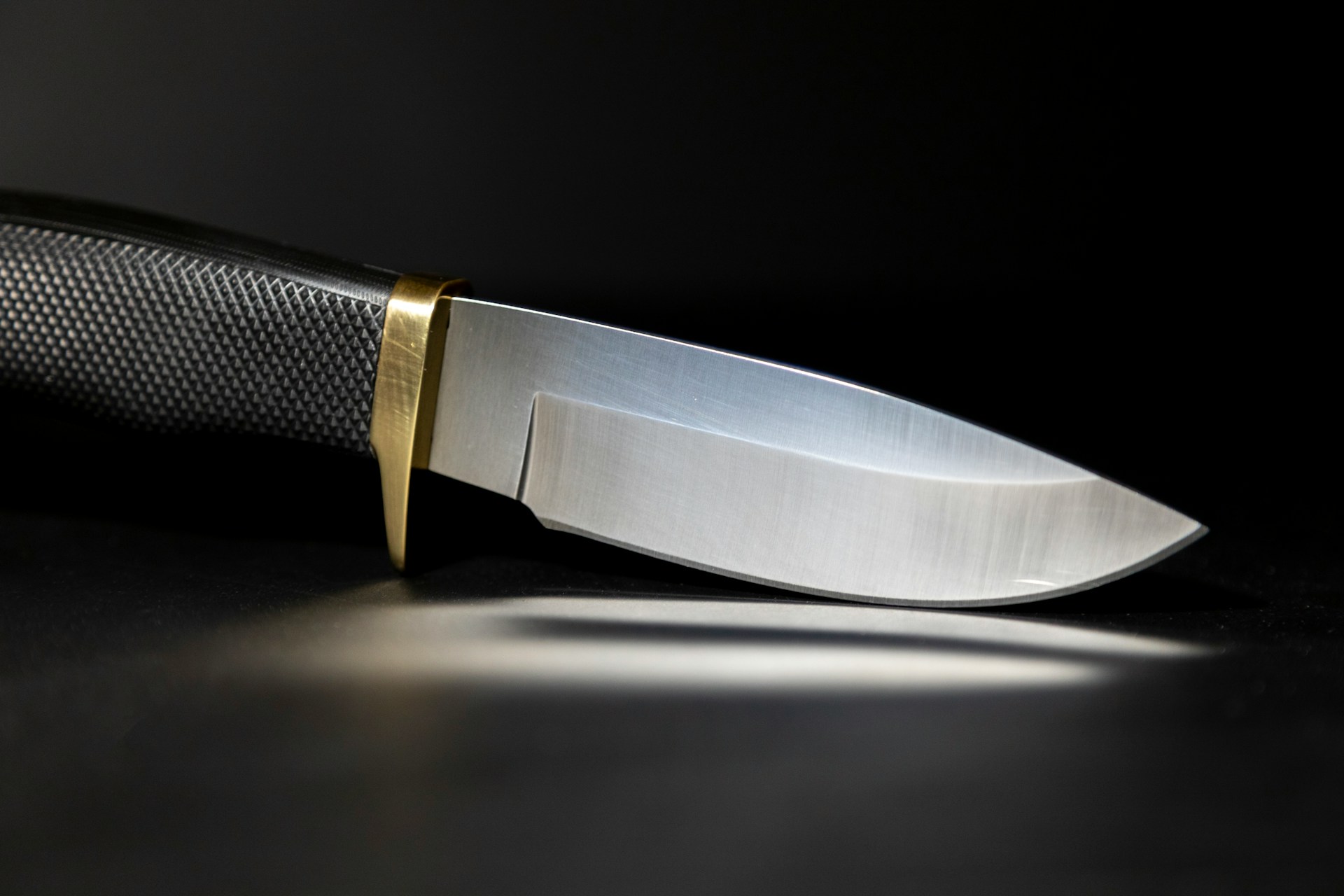
A conventional fixed blade keeps the handle in line with the blade, the same layout you’d see on a kitchen knife, a hunting knife, or a military combat blade. This layout supports slicing, piercing, batoning, and fine detail work. It’s the shape most people picture when they hear the word “knife.”
How the Two Handle Designs Change Use
Handle orientation decides what a knife is good at before you even factor in blade shape. A push dagger’s perpendicular grip channels force straight down your forearm, ideal for a short, direct thrust. A conventional handle lets you rotate your wrist, choke up or back on the grip, and control edge angle for slicing tasks.
- Push dagger: T-handle, blade between the fingers, built for thrusting force
- Conventional fixed blade: in-line handle, full finger and thumb control, built for slicing and general use
- Boot knife: slim conventional handle, longer blade, a middle ground some carriers prefer
That middle-ground option matters. A boot knife-style fixed blade offers longer reach and slicing options but demands more wrist stabilization compared with a push dagger’s straight-line design.
Where Each Format Fits Best
A push dagger fits best as a dedicated backup, not a primary daily tool. Its role is narrow by design: fast access, brutal close-range function, minimal footprint.
A standard fixed blade fits better for anyone who needs one knife to do double duty, cutting rope, breaking down boxes, or handling food prep on a camping trip, while still offering a defensive option. That range of use is exactly why the next question is about grip control under stress.
Grip, Retention, and Close-Range Control
Grip security is where the push dagger earns its reputation, and it comes directly from the T-handle shape. Understanding how that grip behaves in a real fist, compared with a standard handle, explains why serious defensive carriers keep one in rotation.
How a T-Handle Works in a Closed Fist
A T-handle rests across the palm while the blade projects out between two fingers, usually the index and middle or the two center fingers. Wrapping your fist around the crossbar locks the knife into your hand without needing thumb pressure to keep it aligned. The design lets the blade protrude through the closed fist while the crossbar rests securely across the palm.
This geometry makes the push dagger nearly impossible to twist out of your grip in a struggle. Because the handle doesn’t rely on a pinch grip, it holds up under wet hands, gloves, or a frantic grab from an attacker. That’s a real advantage in close-quarters scenarios where disarms are a real risk.
What a Conventional Handle Allows
A conventional handle trades some of that lockdown security for control range. You can choke up near the guard for detail cuts, or extend back on the handle for more leverage on tougher material. Finger grooves, jimping, and guard shape all become tools you actively use, not just passive grip aids.
This is why a standard fixed blade still wins for anyone doing real cutting work: food prep, cordage, fire-building tasks, general utility. The handle gives you the fine motor control a T-grip simply can’t match.
Reach and Blade Alignment Trade-Offs
Reach is the honest trade-off of the T-handle format. A push dagger’s blade rarely runs past 3 inches, and the perpendicular grip shortens your effective range compared with an in-line handle of similar overall size.
A comparable traditional knife typically holds a one- to two-inch reach advantage, which is real but not enough on its own to rule out a push dagger for defensive use. Blade alignment also matters here. A push dagger points straight out from your fist, which limits angle changes mid-strike, while a standard blade lets you redirect the edge with a wrist turn.
That reach gap raises the next practical question: how does each format actually carry day to day?
Concealment, Sheaths, and Everyday Utility
A push dagger conceals more easily than almost any other fixed blade because of its short profile and lack of a protruding handle spine. A standard fixed blade trades some of that discretion for daily cutting versatility.
Why Push Daggers Carry So Compactly
The T-handle design keeps overall length short since the grip doesn’t extend past the blade the way a conventional handle does. Many push daggers run under 5 inches overall, small enough to ride inside a waistband, a boot, or a neck sheath without printing.
Thin blade stock, sometimes as little as 0.12 inches, is a detail most first-time buyers overlook. Collectors know that blade stock thickness, not just overall length, determines whether a knife actually disappears under a shirt or waistband.
Fixed Blades for Daily Cutting Tasks
A standard fixed blade earns its keep on tasks a push dagger can’t touch: opening packages, trimming cordage, food prep, light camp chores. The in-line handle and longer blade give you the leverage and control those jobs demand.
- Fine detail work (whittling, food prep, precision cuts)
- Extended cutting tasks that need a full grip and finger choke-up options
- Prying or light batoning on outdoor trips
- Tasks requiring a visible, openly worn knife rather than a hidden one
This dual-use case is exactly why most serious carriers who like push daggers still keep a standard fixed blade or folder on hand for daily tasks.
What to Check in a Secure Sheath
Sheath fit decides whether a compact knife stays put or becomes a liability. A push dagger sheath needs enough tension to survive a jog or a scuffle without rattling loose, but not so tight that a real emergency draw becomes a struggle.
A sheath “comfortable to wear” is often too tight for a fast draw, while a fast sheath can let the knife fall out during light movement. Kydex sheaths with adjustable retention screws solve this better than basic friction-fit leather. This same tension between convenience and security carries straight into the legal side of the decision.
Legality Can Differ by Knife Type
Push dagger legality does not follow the same rules as general fixed-blade carry, and treating them as interchangeable is a real mistake. Many states name push daggers specifically in their knife statutes, separate from how they treat standard fixed blades.
Why General Fixed-Blade Rules May Not Apply
Most states allow open carry of a standard fixed blade in a belt sheath with few restrictions. Push daggers get pulled into a different category in several jurisdictions because lawmakers group them with other close-quarters weapons.
California is a clear, well-documented example. California Penal Code § 16470 defines a “dirk or dagger” broadly as any knife or instrument, with or without a handguard, capable of ready use as a stabbing weapon that may inflict great bodily injury or death once locked or fixed into position.
Push daggers fall squarely under that definition, which means they’re swept into the same concealed-carry restriction (Penal Code § 21310) as any other dirk or dagger, even though a standard drop-point hunting fixed blade of similar size faces a much lighter statutory burden in the same state.
Other states take a similar mechanism-based approach, sometimes grouping push daggers alongside restricted categories like switchblades and dirks in ways that don’t apply to a plain hunting or utility fixed blade.
State and City Rules to Verify Before Carrying
Blade length limits, open-versus-concealed carry rules, and outright named restrictions all vary by state and even by city ordinance. A push dagger legal to own in one state may still be restricted from concealed carry in another.
Before you carry either format, check these specific points:
- Whether your state names push daggers, punch knives, or T-handle blades specifically in its statute
- Whether fixed blades in your state must be carried openly rather than concealed
- Local city or county ordinances that add restrictions beyond state law
- Blade length limits that apply in schools, government buildings, or specific public spaces
Knife Rights’ LegalBlade app is a genuinely useful tool for checking state-by-state specifics before you buy or carry. Getting this step right before you commit to a carry method sets up the real decision: which knife actually fits the role you need it for.
Match the Knife to Your Carry Role
Choose a push dagger if your priority is a dedicated, fast-access defensive backup, and choose a standard fixed blade if you need one knife that handles both defense and daily cutting. No single format is a universal answer, and the right pick depends on how you’ll actually use it day to day.
A push dagger makes sense as a secondary carry piece, tucked in a boot, waistband, or neck rig, for someone who already carries a primary knife or firearm. Its value is speed and retention in a worst-case scenario, not daily utility. Steel choices on quality models, like CPM 154 or S30V, hold an edge well enough for the occasional cutting task, but that’s not what the design is built for.
A standard fixed blade makes more sense as a primary daily carry for anyone who needs to actually use a knife during the day, not just carry one for protection. It also tends to clear more legal hurdles across state lines, since it doesn’t trigger the specific statutory language that targets push daggers.
Think through your actual routine before deciding:
- Do you already carry a primary blade or firearm, and need a true backup?
- Do you need a knife for regular cutting tasks at work or outdoors?
- Does your state or city name specifically ban daggers in its knife laws?
- Do you value maximum concealment over cutting versatility?
Answering those honestly points most people toward one format as a clear primary choice, with the other as an optional addition later.
Wrapping Up the Carry Comparison
A push dagger and a standard fixed blade solve different problems, and the smart move is matching the tool to the role instead of picking whichever one looks tougher. The T-handle grip gives you unmatched retention and speed for close-range defense, while a conventional handle gives you the reach and control for everyday cutting work.
Legal rules add another layer that first-time buyers often miss, since push daggers face restrictions in places where a standard fixed blade can be carried without issue. Checking your state and city rules before you buy can save you from an expensive mistake down the line.
If you want to feel the difference between a T-handle grip and a standard fixed blade before deciding, Sharp Things OKC keeps both formats in the fixed blade case for side-by-side comparison. Same-day orders placed before the 3 p.m. shipping cutoff go out that day, and the Oklahoma City counter is open for anyone who’d rather hold one in hand first.
Frequently Asked Questions
Is a Push Dagger Better Than a Fixed Blade for Self-Defense?
A push dagger offers faster access and stronger grip retention in a close-range struggle, thanks to its T-handle design. A standard fixed blade offers more reach and versatility, so many carriers keep both: a push dagger as a backup and a fixed blade as a primary tool.
Are Push Daggers Legal to Carry in My State?
Push dagger legality varies by state, and several states name them specifically as a restricted category separate from general fixed blades. Always check your specific state and city knife laws before buying or carrying one, since assuming general fixed-blade rules apply can be a costly mistake.
Why Does a Push Dagger Have a T-Shaped Handle?
The T-shaped handle sits perpendicular to the blade so it locks into a closed fist without slipping. This design channels thrusting force straight down the forearm and makes the knife extremely hard to disarm in a struggle.
Can a Push Dagger Be Used for Everyday Cutting Tasks?
A push dagger can handle light cutting in a pinch, but its short blade and perpendicular grip limit fine control for daily tasks. Most carriers treat it as a dedicated defensive tool and rely on a standard fixed blade or folder for everyday cutting.
Does a Fixed Blade Offer More Reach Than a Push Dagger?
Yes, a standard fixed blade typically offers one to two inches more effective reach than a comparable push dagger. That extra distance comes from the in-line handle, which extends the knife’s overall length beyond what a T-handle allows.
If you have questions about what’s legal to carry where you live, reach out to the shop before you order either format.