Karambit Knife: Is This Curved, Ringed Design Right for Your Everyday Carry?

You have seen the shape somewhere: a hooked blade, a ring at the end of the handle, and a grip that looks nothing like the folder in your pocket. Maybe a friend pulled one out at a knife meetup. Maybe it showed up in a video game. Either way, you are now wondering whether that curved profile is a serious carry option or just a conversation piece.
The honest answer depends on how you cut, how you draw, and how much time you are willing to spend learning a new grip. A karambit is a specialized tool built around retention and pulling cuts, built for a very different job than a clip-point folder, and it rewards people who take the time to actually train with it.
In this guide, you’ll discover what makes the curved blade and finger ring work, where the design came from, how fixed and folding formats differ, and who should skip it entirely. Handle a few before you decide, because a karambit either clicks in your hand immediately or it never will.
What Sets This Blade Shape Apart
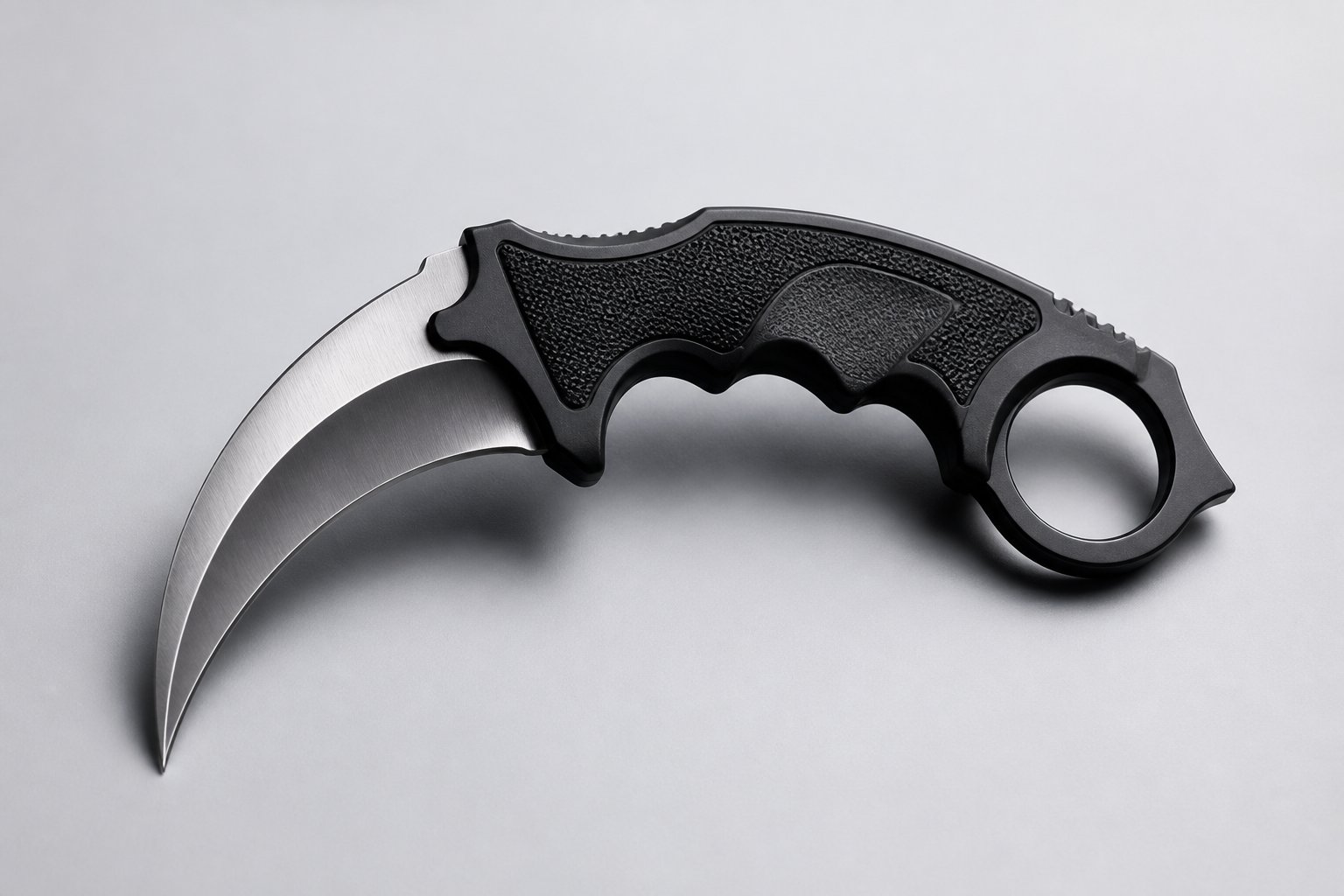
Two features define a karambit: a blade that curves inward like a talon and a ring at the butt of the handle. Everything else about the knife supports those two elements.
The Curved Blade and Hawkbill Profile
The karambit uses a hawkbill blade, meaning the edge sweeps down and back toward the user. That geometry turns every cut into a pulling motion instead of a pushing one.
In practice, this matters more than it sounds. Draw the blade through paracord, zip ties, or a taped box seam, and the material feeds into the curve’s belly. It cannot slide off the edge the way it can on a straight blade.
The trade-off is real. You lose the flat edge section that makes food prep, whittling, and clean flat-surface cuts easy. Hooking and slashing are where the curve earns its keep; slicing an apple is not.
Steel choices run the full range. Budget karambits often use AUS-8 or 8Cr13MoV, mid-tier models step up to D2 or 154CM, and premium builds use CPM-20CV or M390. That last tier holds an edge through months of carry, though recurved edges take more patience to sharpen.
The Retention Ring and Ergonomic Handle
Slide your index finger through the ring and the knife stops being something you hold. It becomes something attached to you.
That is the point. The finger ring means a sweaty palm, a glove, or an impact does not send the knife flying. It also lets you open a door, grab a rail, or use your hand normally while the blade stays indexed to your grip.
Handle materials follow standard knife conventions. G-10 gives you aggressive texture at a low weight. Micarta handles warm up in the hand and grip better when wet. Aluminum and carbon fiber show up on higher-end folders where an ergonomic handle profile is contoured rather than slabbed.
Grip orientation splits users. Forward grip puts the curve out ahead for utility work. Reverse grip, with the edge facing back toward you, is what most trained users default to. Both work, and the ring works with either.
Once you understand how the shape functions, the next question is why anyone shaped a knife this way in the first place.
From Indonesian Farm Tool to Modern Specialty Knife
The karambit began as agricultural equipment, not a weapon. That origin explains the curve better than any tactical marketing copy ever will.
Agricultural Roots in Indonesia
Farmers across Indonesia and the surrounding region used small hooked blades to cut roots, strip stalks, and harvest crops. A curved edge grabs fibrous material and pulls it apart with less force than a straight edge pushing through.
The ring likely came from the same practical need. When working wet fields with wet hands, you don’t want your only tool dropping into the mud. Loop a finger through, and the knife stays put.
From there, the design moved into Pencak Silat and related martial systems, where practitioners recognized that a tool built for control in close quarters translated well to close-quarters technique. The shape did not change much. Its purpose expanded.
How the Design Entered Contemporary Carry Culture
Karambit knives reached American buyers largely through martial arts instruction in the 1990s and 2000s, then accelerated through film and gaming exposure. Demand followed, and manufacturers responded.
What arrived on the market bore little resemblance to the traditional Indonesian blade: modern karambits use liner locks, thumb studs, pocket clips, and Kydex sheaths the original design never had. Blade lengths shrank to fit legal carry limits and pocket-friendly footprints.
That gives you a wide field to shop, from sub-$50 utility folders to $400 titanium-framed pieces with premium steel. The design category is broad enough now that “karambit” tells you the shape, not the price or the purpose.
Which brings up the choice most buyers face first: how the thing carries.
Choosing Between Fixed, Folding, and Kinematic Formats
Karambits come in three practical formats, and the one you pick determines how fast you can access it and how much you will actually carry it.
Fixed Blades and Sheath Carry
A fixed blade karambit is the simplest version: one piece of steel, no moving parts, nothing to fail. Deployment is one motion from the sheath.
Most ship with Kydex sheaths configured for neck carry, belt carry, or inside-the-waistband positions. Fox Knives builds well-regarded fixed karambits, and Emerson’s fixed offerings carry a serious reputation among trained users.
The catch is carry practicality. A fixed blade knife is bulkier, harder to conceal comfortably, and legally restricted in more places than a folder. For many people, that alone settles the question.
Folding Models, Locks, and Pocket Carry
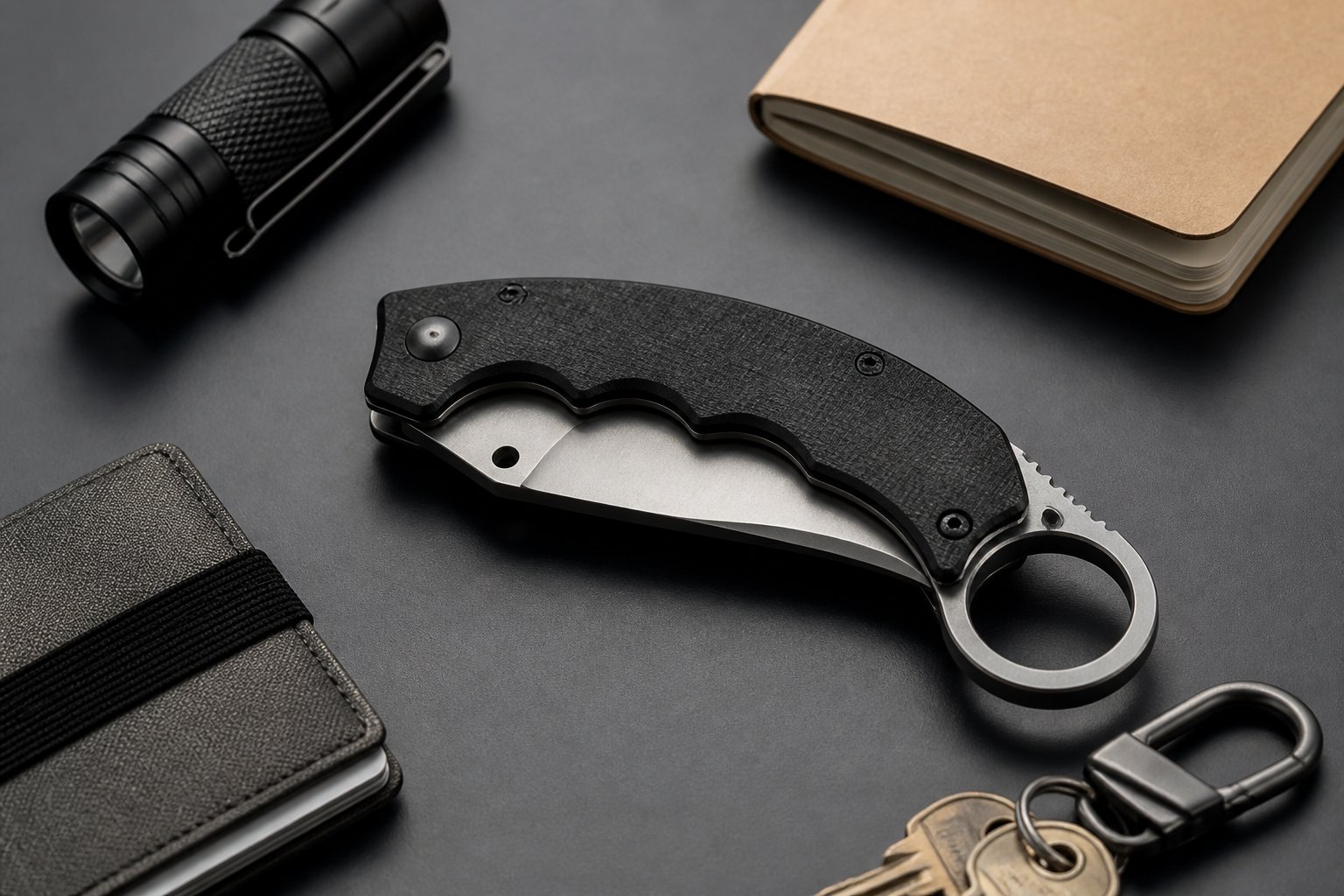
A folding karambit closes the curve into the handle and clips into a pocket. That makes it the realistic daily option for most carriers.
Liner locks dominate this category, with frame locks appearing on higher-end builds. The Kershaw Outlier gives you an affordable, assisted-opening entry point in 8Cr13MoV that is genuinely useful for utility cutting.
Deployment is the honest weakness. Opening a folding karambit with the ring requires practice, and fumbling under stress is a real risk. Learn the motion cold before you rely on it.
Quick comparison when you are deciding:
- Fixed blade: fastest access, strongest build, hardest to conceal, most legal restrictions
- Folding blade: easiest to carry daily, requires deployment practice, lock strength varies by design
- Kinematic/gravity mechanisms: unique one-handed opening, higher price, mechanically more complex, and may carry their own distinct legal classification
Unconventional Mechanisms and Notable Designs
A few designs sidestep the deployment problem entirely. The CRKT Provoke uses a kinematic mechanism where pushing forward on the handle rotates the blade out on a linkage rather than a pivot.
It works. Grip the ring, thumb the lever, and the blade deploys in one continuous motion. The Provoke’s D2 blade typically runs in the $200 to $240 range and remains the most recognizable modern take on the format.
At the higher end, the Reate EXO-K is a genuine gravity knife: a button-and-wrist-flick mechanism drops a Bohler N690 hawkbill blade into place with a fixed-blade feel and folding-blade carry, complete with a removable finger ring and an included trainer for practicing the motion safely.
Worth calling out specifically: gravity knives have historically faced their own distinct legal treatment separate from standard switchblade or fixed-blade rules in some jurisdictions, so this is one to double-check locally before you order, not just assume it falls under general folder rules.
Format sorted, the harder question is whether you belong in this category at all.
Who This Specialized Carry Style Actually Suits
Karambit knives serve a specific slice of carriers well and frustrate everyone else. Being honest about which group you are in saves you money and disappointment.
Experienced Carriers and Trained Users
If you already carry a knife daily and are comfortable with a reverse grip, a karambit knife will feel like an interesting extension rather than a puzzle. You already have the muscle memory for safe deployment and reindexing.
The design also suits people who have trained with curved blades in Silat, Kali, or similar systems. Those systems built techniques around this shape, and the ring makes sense within that framework.
Utility carriers benefit too. Warehouse workers, riggers, and anyone cutting strapping, banding, or cordage all day get real value from a blade that hooks material and pulls through it without slipping.
When a Conventional Everyday Folder Makes More Sense
If this would be your first carry knife, start with a conventional folding knife. A drop point or clip point handles boxes, food, packaging, and every other daily task better than a hawkbill.
The karambit also struggles with anything requiring precision on a flat surface. Cutting a straight line against a ruler, sharpening a pencil, or spreading anything with the flat of the blade is awkward.
Consider a standard folder or fixed blade instead if you:
- Need one knife that does everything reasonably well
- Work around food prep or fine detail cutting
- Are not willing to put in deployment reps
- Carry in a setting where an unusual blade shape draws unwanted attention
If you are still in, the next step is doing it responsibly.
Training, Safe Handling, and Carry Law Checks
Two things separate a responsible karambit owner from someone with a bad injury waiting to happen: practice with a dull blade and a clear read on local law.
Why a Trainer and Deliberate Practice Matter
Buy a karambit trainer before you buy a live blade, or buy both at the same time. Trainers are aluminum or polymer replicas with the same weight and ring geometry, no edge. The Reate EXO-K, for example, ships with one built in.
Spend real time with it. Practice drawing from your carry position, indexing the finger ring, transitioning between forward and reverse grip, and safely closing a folding karambit. That closing motion is where most cuts happen.
Handling a fixed blade knife in this shape has its own considerations. Reseating it into a Kydex sheath one-handed takes deliberate technique, and rushing that is how people cut their support hand.
Verify Local Rules Before You Carry
Knife laws in the United States vary by state and often by city. Blade length limits, concealed carry rules, and restrictions on specific configurations all differ depending on where you stand.
Some jurisdictions treat fixed blades differently from folders. Gravity knives have their own regulatory history in some places, separate from standard switchblade statutes, so a mechanism like the EXO-K deserves its own local-law check rather than the assumption that it falls under general folder rules. None of this is legal advice, and it should not be treated as such.
Check your state statute and your municipal code before you buy, and check again if you travel or move. A five-minute read now prevents a very expensive problem later.
With training handled and the legal picture clear, the last step is finding the one that fits your hand.
Find the Right Fit Before You Commit
Specs on a screen will not tell you whether a karambit fits your hand. Ring diameter, handle length, and blade curve interact differently with every hand size.
Compare Grip, Access, and Carry Options in Person
Start with the ring. Your index finger should sit in it snugly without pinching or sliding. Too loose and you lose retention; too tight and you cannot rotate the knife.
Then check handle length against your grip. Your remaining three fingers need room on the handle without your pinky hanging off the end. On a folding blade, close and open it twenty times to see whether the motion feels natural or forced.
For a fixed blade, test the draw from the sheath position you actually plan to use. What works on a belt may be unusable in a neck carry rig.
Shop With Confidence From Oklahoma City or Online
Handling several karambit models side by side in one sitting tells you more than a week of reviews. Ring size, ergonomic handle contours, and blade weight distribution all become obvious in about thirty seconds.
Sharp Things OKC stocks both fixed blade and folding karambits, including the Reate EXO-K in the gravity knives selection, so you can compare formats in person before deciding.
If you cannot get to a shop, buy from a seller that lists complete specifications: blade steel, blade length, overall length, weight, ring diameter, and lock type. Vague listings usually mean vague quality. Contact the shop with questions before ordering.
Frequently Asked Questions
What Is a Karambit Used For?
Modern karambits handle utility cutting where a pulling motion helps: cordage, strapping, packaging, and cutting seatbelt-style webbing. They are also used in Silat and Kali training and collected for their distinctive design. They are not a good general-purpose kitchen or detail blade.
Are Karambits Legal to Own and Carry in My State?
Ownership is broadly legal in most of the United States, but carry rules vary significantly by state and city. Blade length limits, concealed carry restrictions, and fixed blade rules all differ by jurisdiction. Verify your state statute and local ordinance before purchasing.
How Much Does a Quality Karambit Cost?
Solid entry-level folders with AUS-8 or 8Cr13MoV run $30 to $70. Mid-tier models in D2 or 154CM run $100 to $200, including kinematic designs. Premium karambits with CPM-20CV or M390 and titanium hardware typically start around $250 and climb from there.
Should I Choose a Folding or Fixed-Blade Karambit?
Choose a folding karambit if daily pocket carry is the priority and you are willing to practice deployment. Choose a fixed blade if you want maximum simplicity and strength and can carry a sheath comfortably and legally where you live.
What Is the History and Origin of the Karambit?
The karambit originated as an agricultural tool in Indonesia and surrounding Southeast Asian regions, used to cut roots and harvest crops. The curved blade and finger ring were practical features for wet, slippery fieldwork. Martial systems like Silat later adopted the design.
Which Karambit Blade Steel and Handle Material Should I Choose?
For daily utility, D2 or 154CM gives strong edge retention at a reasonable price. For premium performance and easier maintenance, consider CPM-20CV or CPM MagnaCut. Pair it with G-10 for grip and low weight, or Micarta for better feel in wet conditions.
Curved Blade, Clear Decision
A karambit knife is a specialist. If you want retention, a pulling cut, and a design with genuine depth behind it, this shape delivers something no standard folder can. If you want one knife for every task, a conventional drop point will serve you better, and you should feel no guilt about that.
The deciding factor is almost always the ring and the handle in your actual hand. Ring diameter, handle length, and how the blade balances when you rotate it are not things a spec sheet communicates. Test the grip before you spend.
Come hold it before you buy it. Sharp Things OKC is on N May Ave with fixed and folding karambits on the counter.