The Tanto Blade: Tip Strength, Tradeoffs and Sharpening

The angular tanto blade on a modern folder borrows a Japanese name but very little else from the Japanese dagger it is named after. What you are really buying is a tip built for strength: a straight main edge, a sharp corner, then a short, steep front edge that puts a lot of steel right behind the point. That tip shrugs off stabbing, scraping and prying stress that would snap a fine drop point. The cost is a blade with no curved belly, which makes slicing food and long draw cuts clumsier, and two edges that have to be sharpened separately.
This guide covers where the shape came from, the modern variations, what the tanto blade is honestly good and bad at, and how to sharpen one without rounding off the corner.
Japanese Tanto vs American Tanto
In Japan, a tanto is a short blade, a dagger carried alongside a sword, with a blade typically under about a foot long. Traditional tanto blades came in several forms. Many were flat-sided with no ridge line, and many had a gently curved edge that swept smoothly up into the point, much like a scaled-down sword. There is no sharp corner on most of them.
The angular shape most knife buyers call a tanto was popularized by American production knifemakers in the early 1980s. Its look takes inspiration from the tip of a Japanese sword, where a ridge line called the yokote separates the main blade from the point section. The American version turns that idea into a hard angle on the edge itself.
So when you shop for a tanto folder today, you are almost always looking at the American tanto. The rest of this guide uses “tanto” in that sense unless it says otherwise.
Anatomy of an American Tanto
Three features define the shape:
- Primary edge. The long, straight cutting edge running from the handle forward.
- Secondary point. The corner where the primary edge meets the front edge. Some makers call this the transition.
- Front edge. A short, steep edge that climbs up to the point.
The spine usually runs straight and thick all the way to the tip, or close to it. That is where the strength comes from. A drop point or clip point thins out as it curves toward the tip, while a tanto keeps more steel behind the point. On some designs a grind line runs from the secondary point up to the spine, echoing that sword ridge.
Variants You Will See in the Case
The word covers more than one shape now, and the differences matter in use.
| Variant | Edge shape | Tip | Best at
|
|---|---|---|---|
| Classic American tanto | Straight primary edge, sharp corner, steep front edge | Very strong, set low | Piercing, scraping, rough utility |
| Modified tanto | Front edge flows into the primary edge with a slight curve, or the corner is softened | Strong, slightly finer | All-round carry with a bit more slicing ability |
| Reverse tanto | Edge is a single curve or straight line; the angle is on the spine instead | Fine and pointed, reinforced by the spine angle | Slicing and detail tip work with good strength |
| Japanese style tanto | Curved edge sweeping into the tip, often no corner | Depends on grind | Traditional fixed blades and collectors |
The reverse tanto is the variant that confuses people most. It flips the idea: the edge stays smooth and slices like a drop point, while the spine takes a sharp angled drop near the tip. The Benchmade Osborne is a well-known example of a reverse tanto, and it slices far more like a conventional EDC blade than a classic tanto does.
Where the Tanto Blade Shape Wins
A tanto blade shines on jobs that load the tip.
Piercing tough material. Punching through heavy plastic packaging, thick cardboard, leather or a plastic drum puts force on the point. The reinforced tip resists bending and snapping.
Scraping and light prying. The front edge and secondary point make a good scraper for gaskets, labels and caked-on debris. No folder is a pry bar, but a thick tanto handles side stress better than a thin slicer.
Breaking down boxes. The front edge works like a box cutter, and the primary edge gives a straight line for long cuts through tape and cardboard.
Two edges, two jobs. Some owners keep the front edge a little coarser for rough work and the primary edge finer for clean cuts.
Where It Falls Short
Be honest with yourself about what you cut most.
Food prep. With no belly, a tanto cannot rock on a board, and slicing an apple or a sandwich feels awkward compared with a drop point.
Long draw cuts. The corner interrupts the cut. Drag a tanto through rope or a long sheet of material and the edge transition can catch.
Thick versus thin. Many tantos are ground from thick stock for strength, and thick blades wedge in dense material rather than slicing through it.
Two Tantos at Opposite Ends of the Scale
Thickness changes a tanto’s personality as much as the profile does. Two stocked examples show the range.
The Benchmade Bailout with a CPM-S30V tanto blade is the light end. Benchmade lists the 537BK-06 at a 3.38 inch blade only 0.09 inch thick, with a weight of 2.05 ounces and an AXIS lock. That thin stock means the Bailout slices far better than most tantos, while the tanto tip still gives you extra point strength for packaging and scraping.
The Medford Praetorian T is the heavy end. Medford lists it with 0.190 inch blade stock in solid titanium frames, and the full-size knife weighs 9.3 ounces. Pocket one like the Medford Praetorian T tanto in MagnaCut with a tumbled finish when the jobs ahead involve gouging, scraping and the odd twist at the point, the kind of work that would worry a slim slicer.
Most other tantos sit between those two. The thinner the blade, the better it slices; the thicker, the more it forgives hard use.
Compare tanto blades side by side: pick up a thin Bailout and a thick Praetorian at Sharp Things OKC on N May Ave and feel the difference in hand, or browse all knives at SharpThings.com by blade shape and brand.
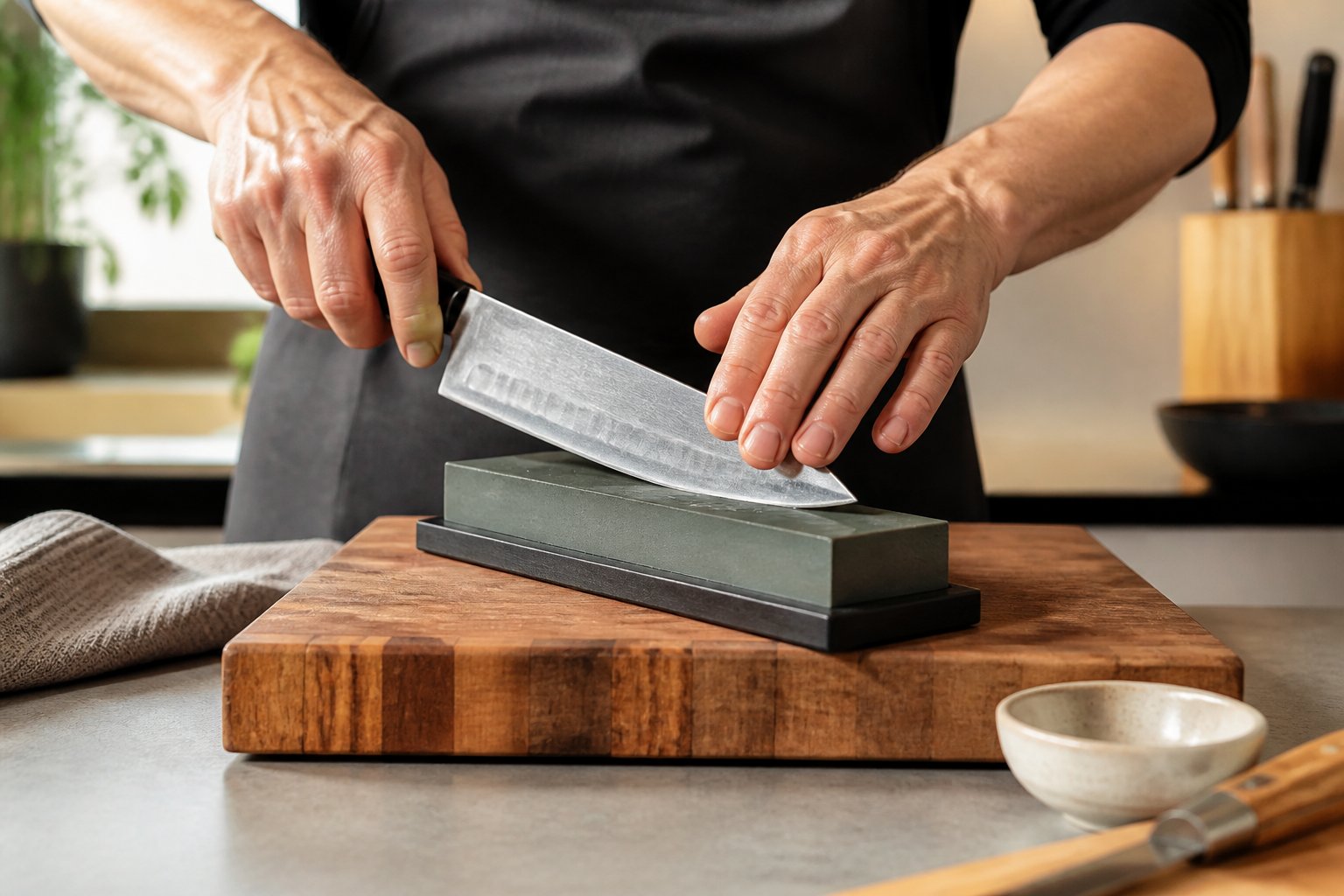
How to Sharpen a Tanto Blade’s Two Edges
The rule is simple: treat the primary edge and the front edge as two separate knives, and protect the secondary point between them. Rounding that corner is the most common way people ruin a tanto.
Start with the primary edge
Lay the primary edge on your stone at your normal angle and sharpen it with straight strokes. Do not sweep or rotate the blade the way you would for a curved belly. Stop each stroke just before the stone runs past the secondary point. Raise a burr along the full length of the primary edge, then switch sides.
Then the front edge
Rotate the knife so the front edge sits flat on the stone at the same angle. Sharpen it with short, straight strokes from the secondary point to the tip. Because the front edge is short, it takes fewer strokes. Raise a burr there too, then switch sides.
Protect the secondary point
The corner is where two bevels meet. If you sweep from one edge to the other in a single motion, the stone rounds the corner into a little curve, and you lose the crisp point that makes a tanto useful. Keep the two edges as two clean, separate motions. Marking both bevels with a felt-tip pen helps you see when you have reached the corner.
Guided systems and rods
Guided sharpening systems handle tantos well, but you will need to reposition the knife or the angle guide for the front edge. On a rod or a narrow benchstone, use the stone’s edge to reach right up to the corner without crossing it.
Finish
Deburr both edges with a few alternating light strokes or a strop, keeping the two edges separate there as well. Our primer on stones, grits and edge angles goes deeper into the technique behind each step.
Is a Tanto Right for You
Choose a tanto if your cutting leans toward boxes, packaging, scraping and tasks that stress the tip, or if you want a hard-use folder that can take abuse. Choose a reverse tanto if you like the angular look but want slicing performance close to a drop point. Skip the classic tanto if you mostly cut food or do long slicing cuts, because a blade with a belly will serve you better.
Find your tanto in person: visit Sharp Things OKC at 6610 N May Ave, open 9AM to 9PM every day, to handle tantos from Benchmade, Medford and more, or shop the Benchmade Osborne reverse tanto in S90V and other tanto knives online.
Frequently Asked Questions
Is a tanto blade good for self-defense?
The tanto’s reinforced tip was designed with piercing strength in mind, which is why it shows up on many tactical knives. Carry and use laws vary widely by location, so check local rules before carrying any knife for that purpose. Our Oklahoma knife laws post covers the basics in this state.
Why do tanto knives have a line on the blade?
That line marks where the bevel of the front edge meets the bevel of the primary edge. On many American tantos it runs from the secondary point to the spine, a styling cue taken from the ridge line on a Japanese sword tip.
Is a tanto harder to sharpen than a drop point?
It takes a little longer because there are two edges, but it is not harder. Both edges are straight, so you do not need to follow a curve. The only real skill is keeping the corner between them crisp.
What is the difference between a tanto and a wharncliffe?
Both have straight edges and strong usable points, but a tanto puts a corner in the edge and keeps a thick spine to the tip, while a wharncliffe has one straight edge with the spine curving down to meet it at a fine point. The wharncliffe is better for precise slicing; the tanto is stronger at the tip.
Can a tanto be used for camping and bushcraft?
It can handle general camp chores, but it is not ideal. Feather sticks, carving and food prep all favor a blade with a belly or a flat-ground drop point. If you prefer a tanto, pair it with a second knife for wood and food work.